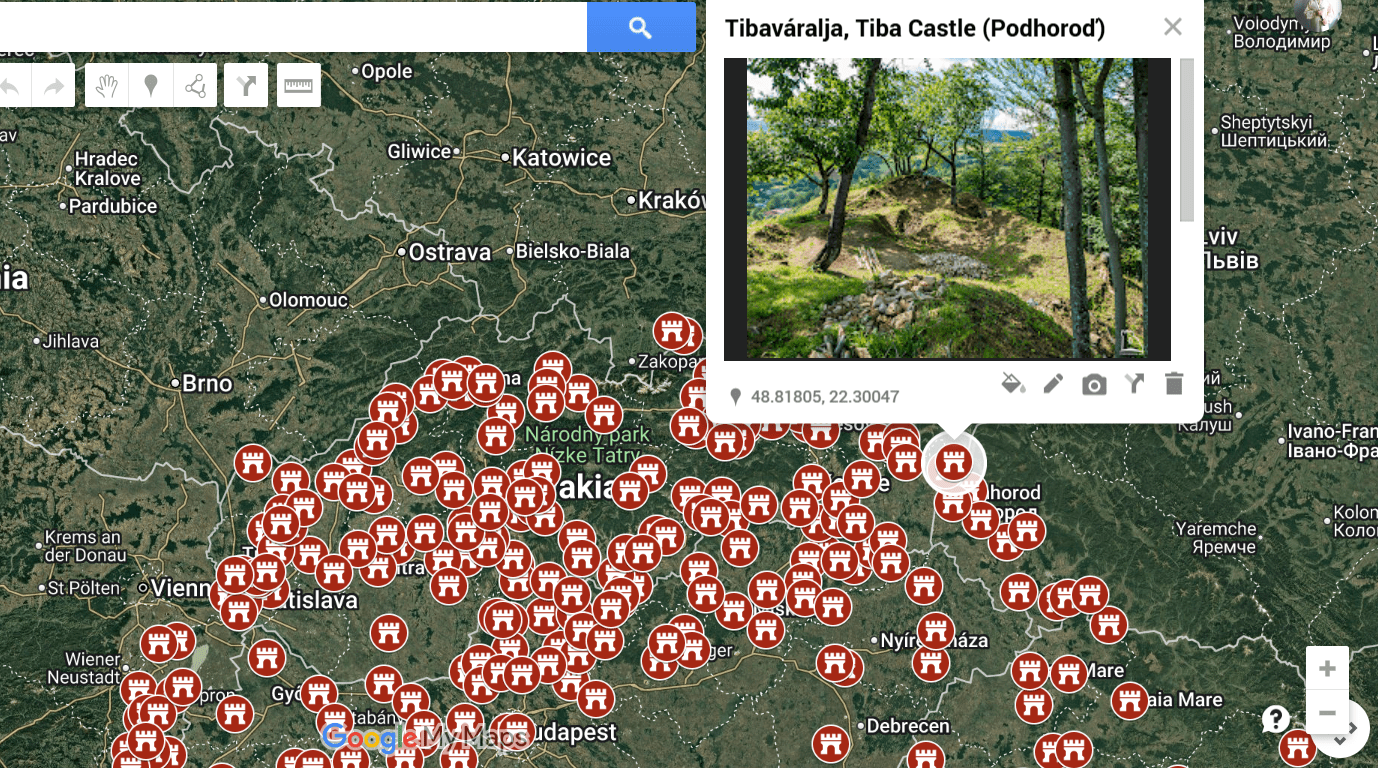


Tibaváralja (Podhoroď) is a village in Slovakia, in the Szobránc/Sobrance district of the Kassa/Košice region. Its small castle, Tiba, was built during the Hungarian Kingdom.
Location on my map: https://tinyurl.com/eyvh9mu7
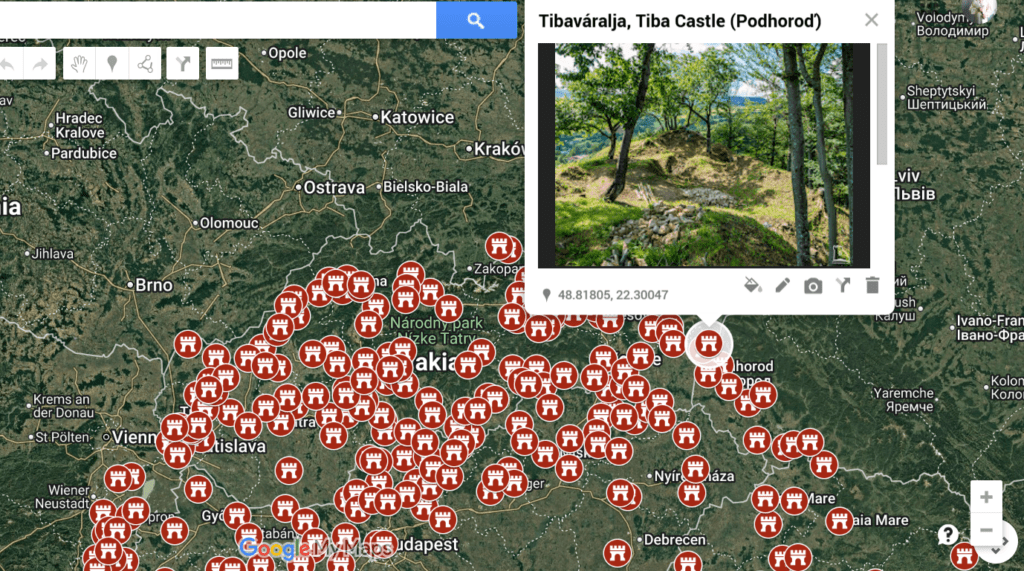
The ruins of Tiba Castle are located at the northeastern end of the village of Tibaváralja (Podhorod’), on a 403-meter-high peak in the Vihorlát Mountains.
The land of Tiba (“quod terram eorum TYBOA vocatam”) belonged to Wolf, Bálint, György, István, Benedek, Donk, and Simon, serfs of Ung Castle, in 1282, which they then received back from King László IV.

The land was seized from them by force by Dávid’s son Finta at an unknown date. In 1283, the king allowed the aforementioned castle serfs to sell their inherited estate in Tyba, Ung County, to anyone, given their difficult circumstances. In 1284, one-third of the land was sold to Felicián, son of Gál, for 80 marks.

According to a document issued by the Eger Chapter, in 1290, the sons of Jakó, the Comes of the Kaplyon clan, Jákó and András, purchased the estate for 300 marks from István, Benedek, Wolf, Bálint, György, Simon, and Donk, serfs of the castle of Ung. They may have built Tiba Castle after 1290.

In 1314, the Nagymihály family (András’ son Lőrinc and Jákó’s son László) sued the parish priest of Ruszka over the church in Tyba. In 1317, Domokos, son of Csicseri Jób, a follower of the rebellious Aba Amadé, occupied it. The Amadé sons were defeated in the battle of Rozgony, and King Károly I returned the estate to the Nagymihály family. The castle was probably destroyed in these battles. In 1336, Pál, the chief magistrate, ordered a border inspection between the two branches of the Nagymihály family. The document does not mention the castle, only the village (“villa Tyba”).

On September 22, 1337, Palatine Drugeth Vilmos mentions it as ruined (“quodqm castro deserto Tybauara vocato”) in his charter. In this charter, the heirs of Nagymihályi András divide the estates among themselves.
According to a document issued by the Eger Chapter on December 22, 1342, there was a bloody conflict between the branches of the Nagymihályi family. The document mentions part of Tiba Castle (“Tybauara”), which was then given to Lőrinc, his sons, and his heirs for perpetual possession.

In 1418, according to a forged(?) document, the Nagymihály family received a new donation for Tyba Castle. However, according to experts, this may have referred to the nearby Alsóhunkóc Castle. Although the castle was probably destroyed during the siege, by 1418 it was inhabited again and fell into ruin in the 16th century.

The village below the castle was founded in the second half of the 14th century and was first mentioned in 1406. It was owned by nobles from Tiba and Nagymihály. In 1599, there were 35 serf houses in the village, but later the population declined.
In 1715, there were 15 taxpaying households, and in 1720, there were 19. Its Greek Catholic parish was founded in the mid-18th century, when it was still inhabited mainly by Rusyns. In 1910, it had 485 inhabitants, most of whom were native Slovak speakers, with significant Ruthenian and German minorities.

Architecture
The castle was built on top of a rocky hill with the steepest slopes on the eastern and northern sides. The course of its defensive walls is difficult to determine, but approximately they had the shape of an elongated oval measuring 40×15 meters. They ran along the edges of the hilltop, adapting to the terrain’s shape. They were massive, up to 2.5 meters thick.

On the south-eastern side of the complex, right on the edge of the rocky slope, there was a massive cylindrical tower (bergfried) with a diameter of about 11 meters and a wall thickness exceeding 3.8 meters at the ground level. Such a large width made it possible to place stairs with a width of 1.2 meters in the thickness of the tower walls. The vaulted room on its ground floor was only 3 meters in diameter. The entrance to the tower was placed in the portal on the first floor level.

A residential building adjoined the tower on the south-eastern side. Its ground floor was a room with dimensions of 9×7 meters and an irregular shape due to the addition of the rounded wall of the tower. The entrance to it was probably on the south-eastern side, where there was a small courtyard measuring 10×15 meters. As it was located about 2 meters lower than the northern part of the castle, the entrance to the building had to be via some kind of staircase or ladder. The entrance to the castle was located on the west side of the castle, in the space between the curtain of the wall and the corner of the residential building.

The only significant part of the castle, about 3 meters high, that has survived to this day, is the remains of a cylindrical tower. No hiking trail leads to its remains and small fragments of the defensive wall. The road to the ruins leads through the slopes covered with trees and shrubs. Entrance is free.

Sources: Szöllösi Gábor https://varlexikon.hu/tiba-vara and https://medievalheritage.eu/en/main-page/heritage/slovakia/podhorod-castle-tibava/
MORE PICTURES ARE BELOW
Dear Readers, I can only make this content available through small donations or by selling my books or T-shirts.
Please, support me with a coffee here: https://www.buymeacoffee.com/duhoxoxa
You can check out my books on Amazon or Draft2Digital. They are available in hardcover, paperback, or ebook:
https://www.amazon.com/dp/198020490X or at https://books2read.com/b/boYd81
My work can also be followed and supported on Patreon: Become a Patron!http://Become a Patron!
Become a Patron! Donations can be sent by PayPal, too: https://tinyurl.com/yknsvbk7


https://hungarianottomanwars.myspreadshop.com/all
Subscribe to my newsletter here https://tinyurl.com/4jdjbfkn
Here are a few pictures of Tiba Castle: