
Let me share with you a guest post by Bárdi Nándor:
The number of Hungarians living in the Carpathian Basin outside the borders defined by the Treaty of Trianon was approximately 2.6 million around 1930. In the same territories, 3.3 million declared themselves Hungarian in 1910, and following the territorial revisions of 1938–1941, this number stood at 3.24 million. During the 1920s, the proportion of state-forming nations increased significantly across the region at the expense of minorities.
Examining the borders of post-Trianon Hungary between 1910 and 1930, the proportion of Hungarians rose from 88.4 percent to 92.1 percent; within Czechoslovakia, in the area of present-day Slovakia, the proportion of Czechs and Slovaks grew from 58 percent to 72 percent; and in Transylvania, the proportion of Romanians increased from 54 percent to 58.2 percent. Hungary’s population grew from 7.98 million in 1920 to 8.68 million by 1930, an increase of 700,000, and by 1941, based on the country’s pre-Trianon territory, it had risen to 9.32 million.

What assimilation and homogenization efforts characterized the nationality policies of the neighboring countries? What could the Hungarian state do to protect Hungarians living beyond its borders? How did Hungary’s diplomatic relations with the neighboring states develop?
Changes in the Hungarian Population
The decline in the Hungarian population was greatest in Czechoslovakia, at approximately 30 percent, while in terms of proportions, the sharpest decline occurred in Burgenland, where the Hungarian population shrank to nearly one-third of its previous size.
The causes of the decline of the Hungarian minority population between the two world wars can be divided into two categories: there were actual demographic processes, and there were census techniques that could be used to manipulate the ethnic composition.
Between 1918 and 1924, approximately 350,000 people moved from the detached territories to Hungary: 197,000 from Transylvania, 107,000 from Upper Hungary (Felvidék) and Carpathian Ruthenia, and 45,000 from the Southern Territories (Délvidék).
The mass of Hungarians with unresolved citizenship status further reduced the Hungarian population.
In Czechoslovakia, approximately 30,000 Hungarians, and in Romania, more than 100,000 Hungarians living there were classified as foreigners for this reason. Resettlement policies also greatly contributed to the changes in the ethnic composition of regions inhabited by Hungarians. A portion of the new settlers replaced the departing Hungarian administrative class. In the border zones adjacent to Hungary, through resettlement programs linked to land reforms—often justified on security policy and social grounds—governments aimed to break up predominantly Hungarian linguistic blocs.
Nearly 120,000 Czech and Slovak officials, workers, and settlers moved to Carpathian Ruthenia and Upper Hungary (Felvidék). In southern Slovakia, over a hundred Czech-Slovak colonies were established along the border zone. In Romania, 34,000 families were resettled in the Partium region and in newly created villages in the Banat. In 1930, Transylvania had 245,000 residents who were not born in that region. In the Southern Territories (Délvidék), more than 50,000 Slavic settlers received land during the Yugoslav land reform in the 50-kilometer-wide border zone, creating new settlements.
In the post-1918 censuses, the Jewish population—which had become predominantly Hungarian-speaking—was classified under the separate category of Jewish nationality, which also resulted in a significant decrease in the number of people counted as ethnic Hungarians.
In Czechoslovakia, five-sixths of the Jewish population that had declared themselves Hungarian-speaking in 1910—approximately 110,000 people—were classified under Jewish nationality, while in Transylvania, 40 percent of them, about 60,000 people, were similarly categorized. Likewise, Hungarian-speaking Greek Catholics were considered Rusyn in Carpathian Ruthenia and Romanian in Transylvania; in the same region, Roma and the Csángó people were also assigned to the majority nation. As a result of these practices, the 1930 census in Romania recorded approximately 100,000 to 120,000 fewer Hungarian-speakers than would have corresponded to actual language use.
Assimilation and Homogenization Efforts
The leadership of the four countries neighboring post-Trianon Hungary—in accordance with the inherited characteristics of their nation-building processes—sought to protect their state frameworks, achieve ethnic unification, and pursue assimilation and homogenization.
However, their efforts to assimilate minorities could not be openly acknowledged in international relations, as it was widely understood at the time that one of the keys to European peace was the protection of the rights of minority populations, which numbered over 40 million.
The international minority protection system, established by the great powers through the peace treaties, was aimed at ensuring equal civil rights and providing protection against linguistic and legal discrimination. In Austria, the situation of the Burgenland Hungarians—who constituted only a fraction of the country’s population by the 1930s and had become integrated into the existing state and provincial system—was not a significant domestic political issue.
In the Hungarian minority policies of Czechoslovakia, Romania, and Yugoslavia, political, economic, and educational-cultural discrimination against Hungarian minority institutions was consistently present.
The efforts of the motherland gave Hungarians living beyond the borders a sense of protective power and the hope of alleviating their difficult minority situation. What these three countries had in common was that after World War I, alongside the dominant majority nation, they also had to contend with significant other national groups.
In 1930–1931, the proportion of Czechs in Czechoslovakia was 50.5 percent, Serbs in Yugoslavia 39.2 percent, and Romanians in Romania 71.9 percent. This made it necessary to involve related nations: through the Czechoslovak nation-building project, the Slovaks, who made up 15.7 percent of the population, were integrated; within the framework of Serb-Croat-Slovene cooperation and later Yugoslavism, the Croats (23.4 percent) and Slovenes (8.1 percent) were organized into a common state framework and political nation.
The Slovenes, who had previously held the status of a crown land in Austria, gained their own institutional system, while the Croats—who had partially possessed such institutions within the Kingdom of Hungary (though lacking, for example, institutional autonomy in military and foreign affairs)—could count on Serbian military protection against Italy (even as anti-Serb Croats had placed their hopes precisely in the Italians).
Significant Hungarian and German minorities lived in these countries.
In Czechoslovakia, 22.5 percent of the population was of German nationality, and 4.9 percent was Hungarian. In Romania, these proportions were 4.1 percent and 7.9 percent, respectively, while in Yugoslavia they were 3.6 percent and 3.4 percent.
The German minority posed a threat of revision only for Prague; in the other two countries—which did not share a border with Germany—German minority politicians followed traditional German minority policy and remained loyal to the government of the day. The Hungarian minorities, however, represented a security policy concern in all three countries.
In Romania, the least nationally diverse of the three countries, two strategies characterized the policy toward Hungarians.
Iuliu Maniu, the leader of the Transylvanian Romanians, advocated an integrative policy that focused not on overt discrimination but on strengthening Romanian society and the economy and building modern Romanian institutions. The foundation of this approach was equal civil rights, in many ways following the pattern of minority policy in pre-1918 Hungary: it reduced the nationality question to issues of language use and entrusted minority education to the churches.
Discrimination Against Hungarians
While the Transylvanian Romanian elite regarded the creation of Greater Romania as the culmination of a long historical process, the Bucharest-based Liberal politician Vintilă I.C. Brătianu viewed Transylvania as a territory acquired through armed and diplomatic means.
Maniu’s concept aimed at achieving economic and social equality for the Transylvanian Romanians—indeed, securing their dominance—but through non-violent methods, relying instead on substantial state support. In contrast, Vintilă Brătianu openly stated that the young Romanian nation must create a new culture to replace the Latin culture manifesting through French influence in the Old Kingdom, the Germanic culture manifesting through Hungarian influence in Transylvania, and the Slavic culture in the eastern part of the country.
In his view, the cultivation of these partial cultures had to be abandoned. He argued that they must be stripped of their economic foundations and that everything should be done to reduce these “higher cultures” to ruins, upon which a new and unified Romanian culture could then be built.
This discriminatory stance essentially became dominant in Romanian state-building.
The Romanianization of Transylvanian cities and the acquisition of economic positions could not have been achieved otherwise in such a short time. In the party political competition, even the slightest concession made to Hungarians drew accusations of being anti-national.
Although the Bucharest government established a State Secretariat for Minorities in 1931, followed by the creation of the office of the Government Commissioner for Minorities and the adoption of a Minority Statute in 1938, these institutions served primarily foreign propaganda purposes and were unable to address the substantive minority issues.
In Yugoslavia, a clearly discriminatory policy was likewise in place.
This was essentially influenced by the state of relations with Hungary, the competition among Serbian parties in Vojvodina, and the fear of Hungarian minority politicians drawing closer to the Croatian Peasant Party. Due to their socio-economic circumstances, the Hungarians in Yugoslavia did not represent a significant counterbalance even on a regional level.
In Czechoslovakia, the edge of discriminatory measures was significantly blunted by the region’s undoubtedly most democratic, pluralistic political system, the relative fairness of parliamentary and municipal elections, functioning local governments, and relative press freedom; for these reasons, greater emphasis was placed on winning the loyalty of the Hungarian population.
A major role in this was played by President Tomáš Garrigue Masaryk, who sought to integrate minorities by ensuring civic equality, language rights, and educational rights. Initially, even Foreign Minister Edvard Beneš promoted Czechoslovak minority policy as that of a “Switzerland of the East.” Indeed, one-third of the Hungarians living there regularly voted for the Social Democratic and Communist parties, which were organized on non-ethnic lines, and in the 1930s, the ruling Agrarian Party achieved 10–15 percent of the vote in Hungarian-inhabited areas.

A common feature of the nationality policies of all three countries was that they did not recognize the right to minority autonomy, even in exchange for loyalty to the state.
At the same time, the nationality policy measures of the three countries did not ensure the individual equality officially proclaimed, in contrast to collective rights. The minority protection treaties formulated in conjunction with the peace treaties ending World War I were initially rejected by the Yugoslav and Romanian prime ministers; after certain concessions, Nikola Pašić signed the treaty, but in Romania, Ioan C. Brătianu preferred to resign as prime minister—consequently, his successor, the Transylvanian Alexandru Vaida-Voevod, ultimately signed the treaty.
Hungary accepted the minority rights obligations incorporated into the Treaty of Trianon without significant debate, as it was more nationally homogeneous than its neighbors, with a minority population barely exceeding 10 percent that was already scattered.
Apponyi Albert, Teleki Pál, and Bethlen István were all aware that the minority treaties made it possible to demand accountability for the rights of Hungarians living in neighboring countries on the international stage. Despite the ratification of the minority protection treaties, none of the countries in the region codified minority rights; they merely declared civic equality in their constitutions and then enforced state interests regarding minorities through various sectoral laws. None of the countries—Hungary included—fully fulfilled the obligations undertaken in the minority protection treaty.
Constitutional Conditions in the Neighboring Countries
Two of the three countries functioned as constitutional monarchies, while Czechoslovakia operated as a civic democratic republic. The real difference lay in the fact that the latter continued the administrative model of the Austro-Hungarian Monarchy, whereas the other two countries followed the administrative patterns of the small Balkan states that had existed before 1918.
While the Monarchy had regional and municipal self-governments, common lands, mining associations, etc., in the Old Kingdom of Romania, for example, the leaders of municipalities were dependent on central authority, and in administration, individuals were defenseless against appointed officials. The same applied to the management of urban assets: in the Monarchy, municipalities and local councils conducted independent asset management.
Consequently, the decentralization of power was interpreted differently in the two political cultures. While in the Monarchy, the guarantee of decentralization was seen in the decision-making powers of elected municipal and county bodies; in the two small Balkan states that had grown after 1918, power was vested in officials appointed from above at the local and regional levels.
The three countries also differed in that in the territories outside the Austro-Hungarian Monarchy—in pre-1918 Romania and Serbia—the role of the Greek Eastern Orthodox Church was decisive, as it had not previously performed the same kind of social functions (such as operating educational institutions) as the churches within the Monarchy.
Similarly, in these two countries, there had been no organized minority groups, and the ethno-cultural communities that existed before national awakening had already been partially assimilated, so they had not had to contend with competing groups tied to other nation-building projects or states until 1918. At the same time, these states served as motherlands for the Transylvanian Romanians and the Serbs in the Southern Territories (Délvidék), and represented a potential alliance for the Croatian and Slovene national movements.
Another difference in the relationship systems of the Czechs, Romanians, and Serbs after 1918 was that the latter two countries expanded with regions that were far more developed than their previous core territories. In Czechoslovakia, the Sudeten German territories were at the same level or only slightly more industrialized than the Czech-Moravian regions, whereas the territories annexed from Hungary were far less developed.
Hungarian Revisionist Efforts and the Little Entente
The primary goal of the Little Entente—the military and political alliance formed in 1921 by Czechoslovakia, the Kingdom of Serbs, Croats, and Slovenes, and Romania—was to prevent Hungary’s revisionist efforts, but beyond this, they were also interested in regional economic cooperation. However, for this to function, Hungary would have needed to be involved as well, which considered the resolution of Hungarian minority issues a precondition for the consolidation of relations.
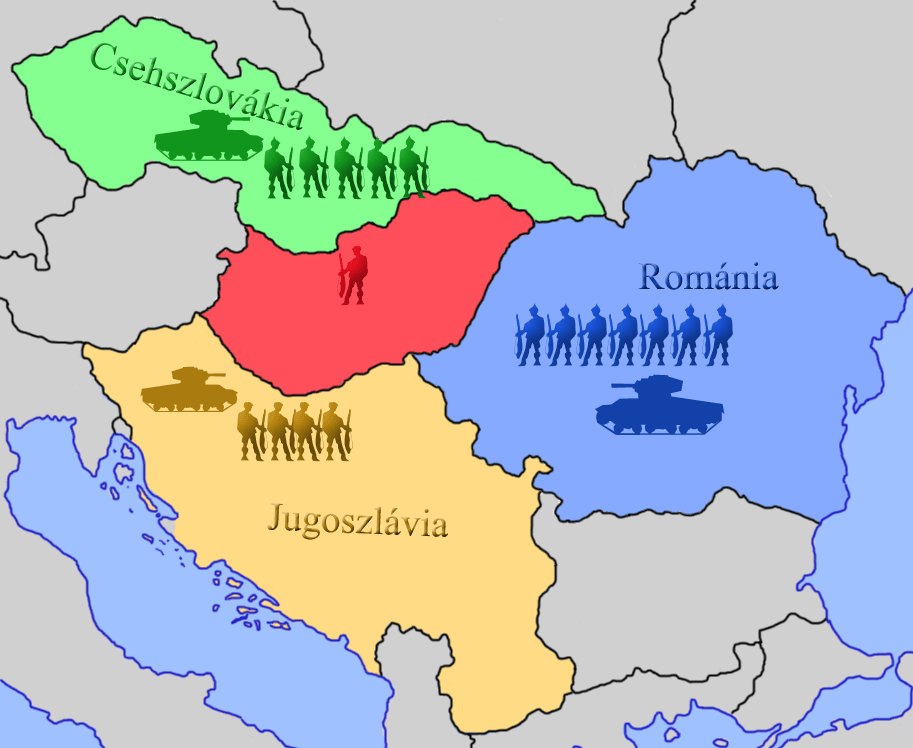
For Budapest, asserting Hungarian interests vis-à-vis the neighboring countries would also have been important, but its military and geopolitical weight did not allow for this. In terms of territory and population, it was only half the size of each of its three neighbors individually. Therefore, Hungary could only count on Italian and German policies, which were dissatisfied with the European status quo, and could hope to persuade British public opinion. For this reason, concerning the Little Entente, Hungary’s most important goal was to break the unity of its member states.
By 1935, it became clear that in the face of the German and Italian threat, the Little Entente states could not rely on British and French support for their defense. Since a simultaneous Hungarian action would have complicated the defense against a potential German or Italian military attack, Yugoslavia and Czechoslovakia sought to normalize relations with Budapest.
Romania opposed this—as it had partly built its domestic political legitimacy on anti-revisionism and the image of Hungary as an enemy—but once its allies were prepared to sit down at the negotiating table without Bucharest, it nonetheless agreed to the talks. Hungary, however, was only interested in reaching an agreement with Yugoslavia and in temporary arrangements with Romania.
In 1935–1936, indeed, the only realistic prospect for revision—with Hitler’s support—was against Czechoslovakia alone. In 1937, the Hungarian government attempted to reach a separate agreement with Yugoslavia, the key points of which were improving the educational situation of the Hungarian minority, ensuring proportionally representative ethnic minority participation in local government, and distributing land from reserve funds to landless Hungarian agricultural workers.
Although Yugoslav Prime Minister Milan Stojadinović appeared willing to address minority issues and to enter into a separate agreement, after the Italian–Yugoslav agreement of March 1937, he rejected Budapest’s initiative, fearing the reaction of its Little Entente allies.
The Bled Agreement and the Munich Agreement
Sensing the weakening of their alliance system, Romania and Czechoslovakia agreed with Yugoslavia at the Belgrade conference of April 1937 that if any of them were to conclude a bilateral agreement with Hungary, they would consult in advance and would seek the consent of the other two allies before signing the treaty.
The parties also agreed that they were willing to recognize Hungary’s military equality (i.e., the revision of the military restrictions of the Treaty of Trianon) if, in return, the Hungarian government concluded a non-aggression pact with them. Discussions on this took place in August 1937 in Sinaia, Romania. Bárdossy László, who represented Hungary and was then the ambassador in Bucharest, made this deal conditional on an agreement that would address minority issues, but the Romanian side firmly rejected this.
At the request of the other two member states, Romania also returned to the negotiating table in Geneva in the fall. Talks were held with Hungarian Foreign Minister Kánya Kálmán, but Romanian Foreign Minister Victor Antonescu remained adamant. Following this, Yugoslavia and Czechoslovakia held Romania responsible for the breakdown of the talks; they declared that they would reach an agreement with Hungary even without Romania. On March 12, 1938, one day before the German troops marched into Austria, the Bucharest government signaled to Budapest that it wished to resume negotiations and would soon establish a Minority Government Commissioner’s Office to address minority grievances.
Discussions continued with the representatives of the Little Entente states, but after Hungarian Prime Minister Darányi Kálmán visited Berlin in November 1937, Budapest’s diplomacy no longer sought an agreement with Prague. This happened although, on the minority issue, it was precisely the Czechoslovak position that was the most flexible, as they had begun drafting a new nationality law, the so-called Minority Statute. It became clear that Hungary would not support Austria with arms in the event of a potential German military occupation, and the Hungarian government agreed with Berlin on the issue of revision against Czechoslovakia.
Hungary’s army was not strong enough to achieve revision through military force, and the neutrality of Yugoslavia and Romania was not guaranteed. Thus, amid the preparations for revision, on August 21–22, 1938, the Little Entente states reached an agreement in Bled to recognize Hungary’s equality in armaments and, through further negotiations, to address the situation of the Hungarian minorities in a benevolent manner that would favorably influence neighborly relations. In exchange, Budapest renounced the use of force to revise borders. However, a month later, the Munich Agreement created a new situation in Central Europe.
Source: Bárdi Nándor (Rubicon)
Dear Readers:
You can help my work here: https://www.hungarianottomanwars.com/donate-my-work/