“You Sons of the Jászkun Heroic People!” – The Lehel Hussars in 1848/1849
by Zoltán Babucs
In the “year of wonders,” 1848/1849, the Jászkun District, with a population of 176,000, performed well beyond its means. Besides the imperial-royal 12th Nádor Hussar Regiment, whose soldiers had deserted from Bohemia, they mounted the 14th Lehel Hussar Regiment, raised the 24th White-Cap and the 65th Honvéd infantry battalions, and their recruits also served in other Honvéd units – eventually, from May 1849 onward, on Kossuth’s orders, exclusively with the hussars. In this way, they provided at least 6,000–7,000 soldiers to the Honvéd Army and mobilized at least as many National Guardsmen and popular insurgents whenever the order came.

Although the Hungarian Parliament passed the conscription law at the end of August 1848, the monarch did not sanction it. However, on 12 September, in consideration of saving the “homeland in danger,” Parliament nevertheless put this law into effect by resolution: for each district, two recruits had to be provided for every 127 inhabitants, so the Jászkun District had to muster 2,958 men.
Regarding the Jász and the Kun (Cuman) people, you can read more on my page: https://www.hungarianottomanwars.com/charters-and-coexistence-part-2-the-cumans-and-jasz-steppe-warriors-of-the-hungarian-plain/

Because the Jászkuns believed that even the Lord God had created them on horseback, they themselves volunteered to raise a hussar regiment, which Prime Minister Count Batthyány Lajos gladly acknowledged. On 27 September, the organization of the “Lehel Horsemen” began. At that time, the cavalry of the emerging Hungarian army still consisted of the old imperial-royal hussar regiments; to augment it, six new regiments were raised. Thus, the Jászkun Hussars were initially designated as the 2nd Honvéd Hussar Regiment in early October, and from 3 December as the 14th Lehel Hussar Regiment. This further strengthened Jászkun pride, as evidenced by a contemporary report: “The Jászkun District would not give up for all the world that it has two cavalry regiments: the Nádor and the Lehel Hussar Regiments.”

Most of the remounts were also provided by the Hármaskerület (the Jászkun District) (e.g., Kiskunfélegyháza provided 500 horses!). However, during the autumn, the colt stock that entered training initially caused many problems for the hussars. The companies began training and equipping in the settlements of Jászság. One recruit of the 1st Hussar Company, Potemkin Ödön (later Egervári), immortalized this period as follows:
“The first riding exercises took place on a blanket seat strapped down with a girth. Our horses, being mostly 3–4 year old colts, which had been rounded up mainly from the wild herds roaming the endless plains of the Great Hungarian Plain, one can imagine how difficult their taming was. During the riding exercises, our recruits fell to the ground very frequently at first, and the first saddling of our horses cost us no small effort. However, we, together with our horses, underwent a true trial by fire when we finally all received sabres, strapped them on, and mounted, and especially when, on command, we had to draw sabres all at once. This was accompanied by a great clatter, upon which our wild colts, frightened in an instant, scattered running, and rare was the man who could stay in the saddle.
Our equipping was rather slow, for until the late, cold autumn our uniform consisted of mere tatters, and this delay greatly hindered our eagerness to go to war.”

Kossuth originally wanted to use the uniform of the Lehel Hussars as a model for the other newly forming hussar regiments, but the military situation and the country’s productive capacity did not entirely allow this. Their uniform is known from the description of Major Ernő Kovách, commander of the 30th Honvéd Battalion in Hódmezővásárhely: “Their attire consisted of grass-green shakos with horsehair plumes, on the front of the shako a brass crest depicting Lehel’s horn, and dark blue pelisse, dolman, and trousers with red braiding. Like on the other new hussars, the dolman and pelisse had five rows of braid with snail-shaped buttons and brass ‘dovecote’ (brush holder) knots. – The pelisse and dolman were not short, reaching only to the hip as on the old hussar regiments, but extended more than a hand’s breadth below that, like a short Attila-dress. The pelisse was trimmed with white lambskin, and they had white cartridge belts […] Their sabretache, next to the sabre, was made of red cloth with a white metal plate bearing the coat of arms of Hungary.”
It is presumed that they initially used Lehel’s horn coat of arms motif, although there is no material or pictorial evidence of this; however, later, the pressed German silver (pakfong) small crowned Hungarian coat of arms was placed on the shakos of the Lehel Hussars. The officer’s knot (vitézkötés) on the grass-green shako was originally made of red cord, but they also used the red-white-green “friar’s knot” type of the mounted national guard. In place of the delicate hussar trousers, they wore a much simpler and more practical gray cloth riding breeches with red side piping and 24 cm high leather lining at the bottom, the so-called “rajthuzli” (racing breeches).

At the beginning of November, one division (companies 1–2) of theirs was sent to the siege army at Arad, but during their journey, they also had to perform military police duties in Orosháza. On December 15, their 3rd company also arrived at Arad, followed by another two squadrons (7th–8th) in April 1849.
At the end of December, under the command of Major Bobory Kálmán, one division (companies 4–5) of Lehel Hussars was assigned to the Upper Tisza Corps, but their training deficiencies initially caused problems. On December 28, they underwent their baptism of fire near Szikszó.
“One division of Lehel Hussars under the command of Major Bobory launched a brief charge against the enemy cavalry on the left flank; however, after a few grenade shots, the recruit hussars became confused and were forced to retreat, whereby not only did they themselves get into trouble – as during the retreat a few weak riders fell from their saddles – but they also disheartened the entire division with their flight.”
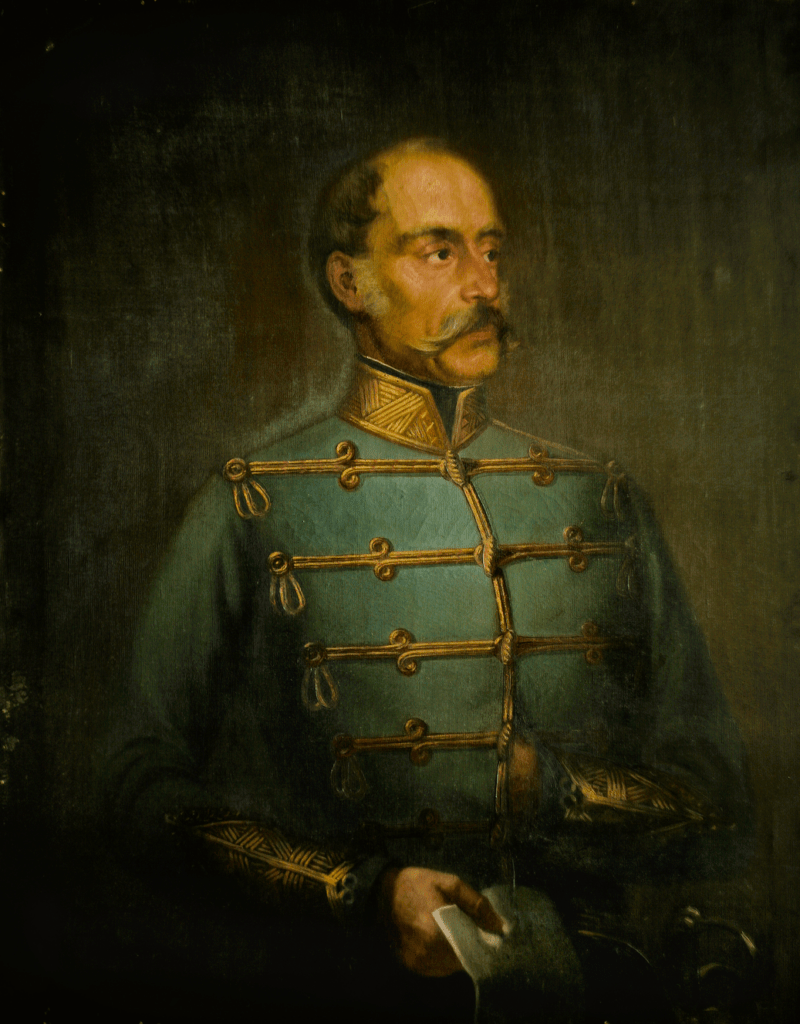
We can also read about this fiasco in the memoirs of Lieutenant General Mészáros Lázár: “We had advanced barely a few hundred paces when the explosion of a wretched shell threw the Lehel Hussars on the right wing into disorder; they began to run back rapidly, but with great difficulty were finally stopped.”
It also happened later – for example, on January 4, 1849, near Kassa (Košice) – that Lehel Hussars kept falling off their mounts, and their horses wandered on the battlefield with the saddles turned under their bellies, which is why the ever-sharp soldier’s humor stuck them with the nickname “Lehull (Fall-Down) Hussars.”

The Lehel Hussars, belonging to the Upper Tisza Corps, learned from their mistakes, and thus they fought bravely at Tarcal (January 22), Bodrogkeresztúr (January 23), the Kompolt raid (February 18), and at Kápolna, during the Verpelét hussar charge on the second day of the battle (February 27).
The 6th company of the Lehel Hussars arrived at Major General Perczel Mór’s Central Mobile Army at the end of December and fought valiantly in the Battle of Szolnok on January 22, 1849.
During the Spring Campaign, their 4th and 5th companies fought in the ranks of the I Corps, and the 6th company in the II Corps; then, after the capture of Buda, their companies belonging to the I Corps were transferred to the VIII Corps at Komárom.
Meanwhile, the 7th and 8th squadrons also arrived at the siege army of Arad, and part of them were able to enhance the reputation of the Jászkun Hussars as early as April 9. On that day, about half a squadron of imperial Uhlans tried to deliver food into the fortress, but “[…] they were repulsed from Szentmiklós (Sânnicolau Mare) by a few sections of the three-week-old soldier Lehel Hussars and pursued as far as Keresztes […]”

One of their finest feats of arms occurred at Temesvár (Timișoara) on April 29, when the imperial troops breaking out of the fortress forced a Hungarian brigade near Freidorf to retreat. However, the commander of the 3rd Company of Lehel Hussars, which stood in reserve, Senior Captain Deéssy Gergely, ignored the order of the brigade commander, Lieutenant Colonel Peretzi Mihály – and, according to the description of Lieutenant Potemkin Ödön – encouraged his 75 hussars to attack with these words:
“Hussars! You sons of the Jászkun heroic people, the moment has finally arrived to prove the bravery inherited from your fathers! Show the world that you are brave not only at home on your wilderness plains but also on the battlefield, and that you do not retreat before the fearsome long lances of your enemies, infamous as they are.”
The enraged Lehel Hussars boldly charged the Schwarzenberg Uhlans, who were two divisions strong – meaning four squadrons – and the victory that day was thanks to them. Major General Count Vécsey Károly immediately awarded Captain Deéssy with the 3rd class of the Military Merit Cross, for which, in addition, he also received two weeks of arrest for disobeying orders.
The regiment’s commander was Lieutenant Colonel Rákóczy-Parchietich Zsigmond, a division commander, but in practice, Major Mészöly Farkas commanded the hussars. It is known that during their encampment at Arad and later at Temesvár, the Lehel Hussars had their own band, which was led by a trumpeter-conductor and consisted of six trumpeters.

On August 9, near Temesvár, two sections of Lehel Hussars provided the escort for Lieutenant General Józef Bem. After the lost battle, Lieutenant Colonel Mészöly kept his hussars under iron discipline as long as possible, but dejection, starvation, and wine drunk on an empty stomach took their toll. Except for 35 men, the five companies of Lehel Hussars saddled up and went home.
The three companies of Lehel Hussars assigned to the defenders of Komárom were reinforced on September 6 by an additional hussar company through the assignment of the cavalry of the Noszlopy Free Corps.
The last cavalry feat of arms of the War of Independence is connected to the Lehel Hussars. Szinnyei József, a first lieutenant in the 203rd Honvéd Battalion at Komárom, preserved the following memory of the hussar trick at Hetény on September 5: “On September 5, our outposts stationed at Ó-Gyalla and Szentpéter reported that they had been attacked by Cossack divisions.
Upon hearing this news, Klapka, driven by an irresistible desire, wished to see the world-famous Cossacks face to face; therefore, taking a few officers from his staff with him, he went to Hetény.
Three companies of Lehel Hussars under the command of Major Csomortányi Lajos were stationed in a concealed position in front of the village when they saw a Cossack force of about 300 men approaching slowly in a dense mass on the road from Ó-Gyalla. A few of the horsemen, who had arrived about 700 paces from Hetény, separated from the group and, galloping forward, fired their long rifles at our hussars.
Klapka decided to engage the Cossacks a little. Since our men knew the area well, they left one company in a concealed position near Hetény, while the other two withdrew into a nearby forest, thus intending to outflank the Cossacks unnoticed from the side. The company stationed at Hetény was ordered to stage an apparent retreat, thereby luring the Cossacks closer.
The ruse succeeded. Our hussars had scarcely turned their backs on the enemy when the entire group rushed after them as if enraged and had almost reached Hetény when Csomortányi dashed forward with his two companies from the forest and attacked the Cossacks from the flank and rear; at that, they ran back screaming. The company before Hetény also did its duty, and thus the Cossack gentlemen were thoroughly thrashed. They captured 12 prisoners and cut down seven, and chased the rest beyond Szentpéter.
The whole afternoon was peaceful. The Cossacks only showed themselves at a respectful distance. In the evening, however, a large cavalry division emerged from Ó-Gyalla, which was recognized as regular cavalry. Our men had no desire to engage with them, but adorned with pikes, rifles, pistols, and handjars (daggers), they withdrew into the fortress.”

Among the prisoners, some of whom were cruelly left where they fell, belonged to a Don Cossack regiment; they were stocky men but miserably equipped. When they were brought before Klapka, they touched the ground with their foreheads and begged for mercy. Their horses were not worth much, even though our men had counted mainly on them; they were all small, skinny, and neglected. Regarding their saddles and bridles, it was a true mystery to us how they could manage with such gear.
Csomortányi reported later that same evening, late, that he had been forced to retreat to Izsa, pressed by a strong Russian Uhlan cavalry division. However, near Kurtakeszi, with his three companies, he launched a brilliant attack against this division and pushed them back, and the men captured two fine, large horses.”
When Komárom surrendered in exchange for amnesty between October 2–4, 1849, the two divisions of Lehel Hussars there, like the other units of the fortress garrison, laid down their arms.
One of the divisional colors of the Lehel Hussar Regiment – a 72 x 95.5 cm white silk banner, decorated on the obverse with the small Hungarian coat of arms and on the reverse with an oil painting of the Virgin Mary (Protectress of Hungary) with the Christ Child – did not fall into the hands of the victors and has survived to this day in the Jász Museum, albeit in a heavily deteriorated condition.

Their officer, Second Lieutenant Pintér Adolf, removed it from its staff at the time of the defeat at Temesvár, and, like other Honvéd regimental colors, it was hidden by adventurous means during the era of oppression. For a long time, a swallow-tailed hussar flag dating from the first half of the 18th century was mistakenly attributed to the Lehel Hussars, even though, as early as 1875, a newspaper report informed that the regular ‘Type B’ cavalry divisional color of the Lehel Hussars had been returned to Jászberény:
“The recently opened Jászberény Museum has acquired a precious relic of our War of Independence, as the Szegedi H.[íradó – BZ] writes. It is the flag, or rather the remnants of the flag, of the Lehel Hussar Regiment, which was formed exclusively from Jászkuns. Having already endured many vicissitudes, it has nevertheless remained intact enough that on one side the Hungarian coat of arms, on the other the image of Mary with the infant Jesus can be recognized.”
Article by Babucs Zoltán, military historian (Institute for Hungarian Studies, Historical Research Center)
Dear Readers, I can only make this content available through small donations or by selling my books or T-shirts.
Please, support me with a coffee here: https://www.buymeacoffee.com/duhoxoxa
You can check out my books on Amazon or Draft2Digital. They are available in hardcover, paperback, or ebook:
https://www.amazon.com/dp/198020490X or at https://books2read.com/b/boYd81
My work can also be followed and supported on Patreon: Become a Patron!http://Become a Patron!
Become a Patron! Donations can be sent by PayPal, too: https://tinyurl.com/yknsvbk7

https://hungarianottomanwars.myspreadshop.com/all
Subscribe to my newsletter here: https://tinyurl.com/4jdjbfkn