

On January 9, 1778, Count Bercsényi László, France’s only Hungarian marshal and son of Bercsényi Miklós, passed away. He retired after achieving the highest military rank in France.
Count Bercsényi László, Rákóczi’s lieutenant and Hungarian-born marshal of France, was born in Eperjes in 1689. The only son of Kuruc General Count Bercsényi Miklós led an adventurous life.

He was only two years old when he lost his mother, Homonnai Drugeth Krisztina. He was raised by relatives in Galgóc, then after his father remarried, they moved to Ungvár, where Rákóczi Ferenc II was a frequent guest. When the elder Bercsényi followed Rákóczi, who had escaped from captivity in Bécsújhely, to Poland, the boy was sent by the Viennese authorities to the Jesuits in Kassa.
In 1703, at the outbreak of the War of Independence, he fled from here, was captured, and treated as a prisoner of war. He was released only a year later and entered the prince’s court school. He began his military service in July 1708 in the noble guard as a cornet, then as a second lieutenant. He was baptized by fire in the Battle of Strazsnica, and by August, he was already celebrated as a hero: he was one of the rescuers of the wounded prince at Trencsén.

In February 1711, he went to Poland with Rákóczi, where he was commissioned by the prince to gather information about the intentions of the Prussian court. In 1712, Rákóczi sent him to France, where, at his recommendation, King Louis XIV retained Bercsényi’s rank and transferred him to one of his most distinguished units, the 1st “gray” cavalry musketeer company.
In December 1712, the young Hungarian requested a transfer to the Ráttky Hussar Regiment, which was fighting against the Habsburg army in the War of the Spanish Succession and consisted largely of Hungarians. The following year, at the age of 24, he was promoted to the rank of vice-oberst (lieutenant colonel).
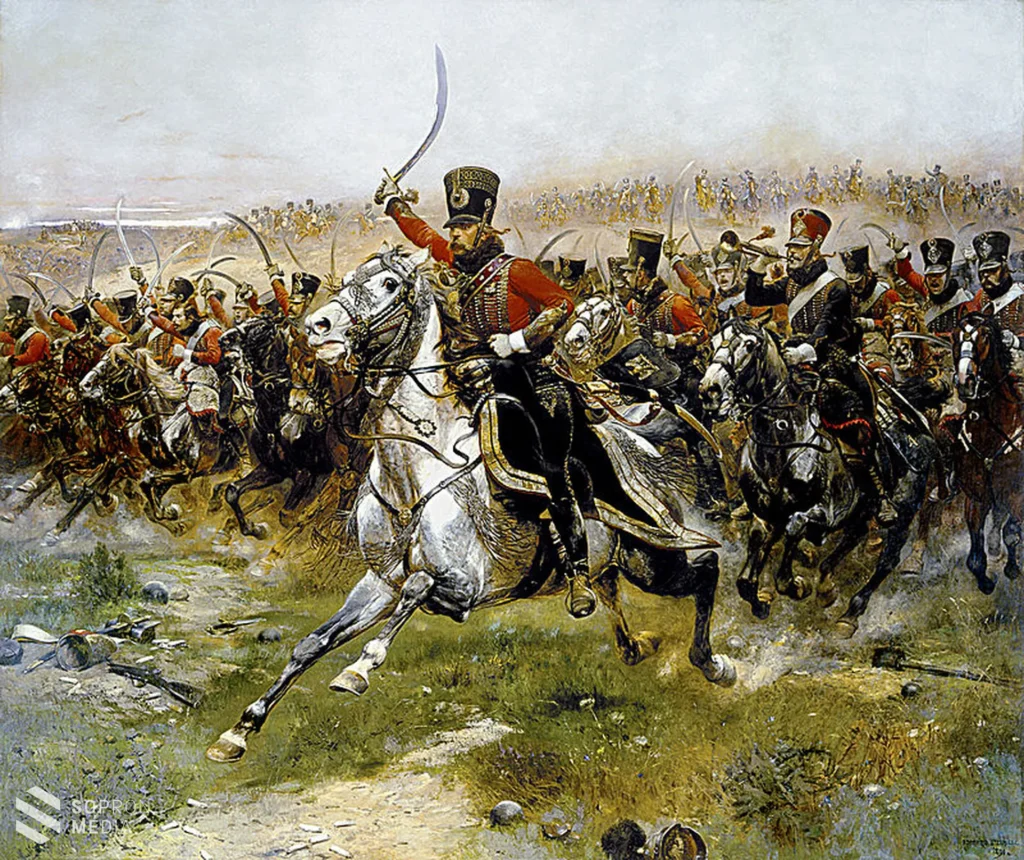
Six years later, in 1719, he became a colonel in the Franco-Spanish War and received one of France’s highest honors, the Knight’s Cross of the Order of Saint Louis. He also visited Rodostó, but returned to France after the Turkish defeat in the Austro-Turkish War. In 1720, he was granted permission to recruit a hussar regiment for the French king, mainly from Hungarian exiles in Turkey.
In the 1720s, Bercsényi became the first chamberlain and then governor of Leszczyński Szaniszlo, the deposed Polish king living in France and father-in-law of Louis XV. He was naturalized as a nobleman and received an estate. He participated in the Polish War of Succession from 1733 to 1735 with his regiment, was appointed brigadier, and in 1738 was appointed general of the army.

In 1740, he attempted to return to Hungary, but his attempt failed, and he requested a position in the French army marching against the Habsburg forces in the Austrian War of Succession from 1741 to 1748. For his outstanding deeds, he was awarded the Commander’s Cross of the Order of St. Louis, became chief inspector of the hussars, and was promoted to lieutenant general in 1744. He was so highly favored by the monarch that Louis XV allowed him to wear the Hungarian hussar general’s uniform.
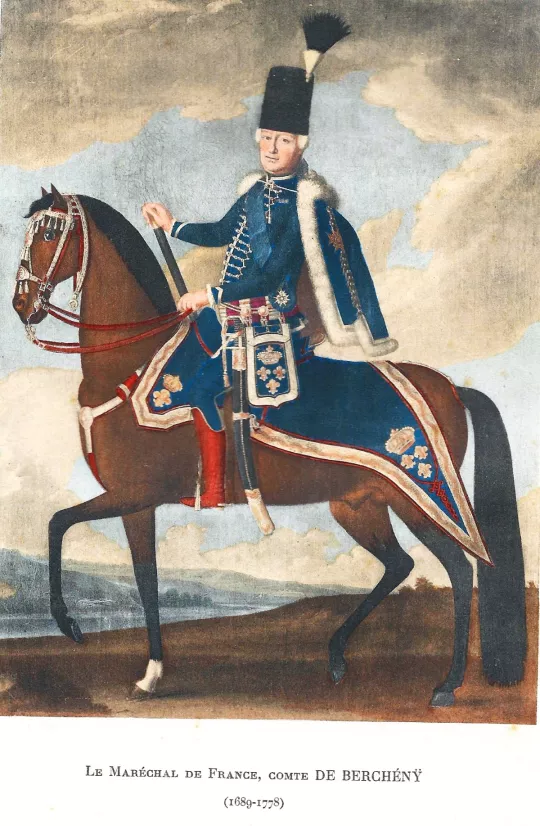
In 1748, he was appointed governor of the Duchy of Commercy, and in 1753, he was awarded the title of Grand Cross of the Order of Saint Louis. For his steadfastness during the Seven Years’ War, which broke out in 1756, he was promoted to Marshal of France in March 1758, and a year later, he became a general, i.e., the senior commander of all hussar commanders. As there was already an alliance between the Bourbons and the Habsburgs at that time, he requested retirement after attaining the highest military rank and lived in seclusion on his estate with his family.

He died on January 9, 1778, in Luzancy, near Paris. Ownership of the hussar regiment he had established and named after himself passed first to his two sons, then, after the French Revolution, to the people, and was given the number 1 in the order of battle. After the cavalry was disbanded, the 1st French Parachute Regiment in Tarbes took the name of László Bercsényi, as did Europe’s only hussar museum (outside Hungary), located in the southern French city of Tarbes.
In Hungary, the Hungarian Armed Forces’ 34th Bercsényi László Special Operations Battalion in Szolnok bears the name of the Hungarian-French hussar commander, whose statue can be seen in the garden of the Vay Ádám Museum in Vaja.
(Source: mult-kor)

Dear Readers, I can only make this content available through small donations or by selling my books or T-shirts.
Please, support me with a coffee here: https://www.buymeacoffee.com/duhoxoxa
You can check out my books on Amazon or Draft2Digital. They are available in hardcover, paperback, or ebook:
https://www.amazon.com/dp/198020490X or at https://books2read.com/b/boYd81
My work can also be followed and supported on Patreon: Become a Patron!http://Become a Patron!
Become a Patron! Donations can be sent by PayPal, too: https://tinyurl.com/yknsvbk7

https://hungarianottomanwars.myspreadshop.com/all
Subscribe to my newsletter here: https://tinyurl.com/4jdjbfkn