


Magaré (Romanian: Pelișor, German: Magarey) is a village in Romania, in the Transylvanian county of Szeben (Sibiu). It is famous for its Saxon fortified church, which was built in the 15th century in the Kingdom of Hungary.
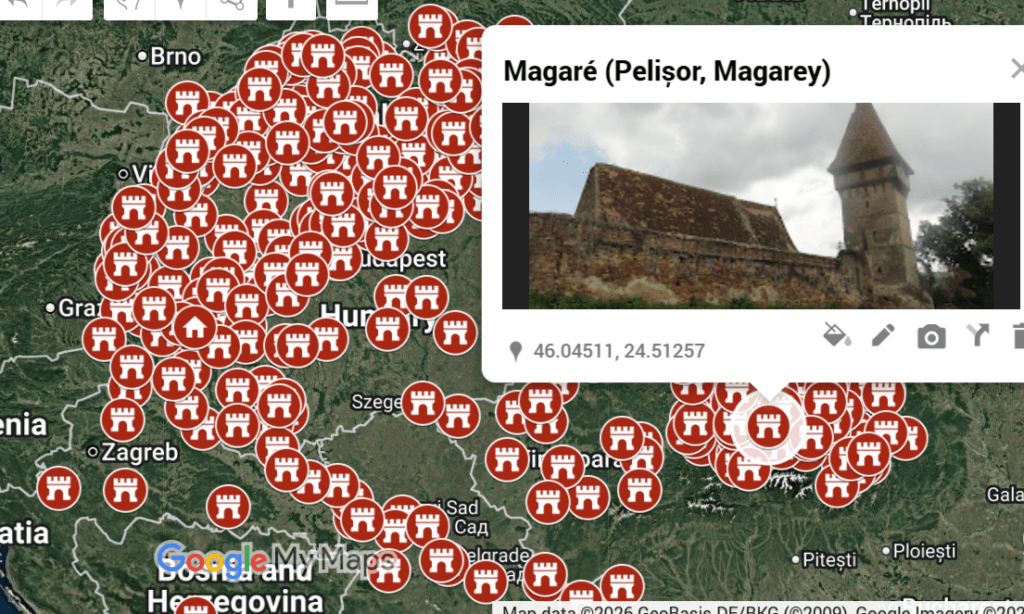
Location: https://tinyurl.com/42cfuwaf
Its first written mention survives from 1357, in the form possessio Magare. Its Gothic-style hall church was built in the 15th century, initially without a tower, and later surrounded by a stone wall. Three rows of loopholes were created on its fortress wall.

Access to the church is through two portals, one southern and one western, both ornamented in the Gothic style. With the structural modifications of the 18th century, the vault of the chancel was replaced with a simple brick vault. At the same time, the gate tower of the fortification began to serve as a bell tower; it is the tallest of all and has five levels. This tower was most likely erected in the first decade of the 16th century and houses one bell, the small one, dated 1512.

Altogether, it was reinforced with four towers. The gate tower is located on the southeastern side, featuring a massive gate and a portcullis, with the first floor of the tower serving as a dwelling. On the eastern side, a small tower can be seen, which served to defend the pedestrian access to the church. On the southwestern and northwestern sides, the walls were flanked by two massive towers.

On the side most exposed to the slope of the hill, towards the west, a wall was erected in the 17th century, featuring one row of machicolations and two rows of loopholes. In front of this wall, which effectively doubled the fortification, a defensive ditch was dug. The walls of the second curtain are approximately 10 meters high and feature a wall walk, alternating with embrasures and crenellations.

The northwestern tower originally had a lean-to roof; today, it is destroyed. The smallest tower is the eastern one, which is near the church’s axis.

Throughout its history, Magaré was involved in numerous disputes with Berethalom (Biertan), a much larger Saxon settlement with a substantial population. Thus, until the 19th century, Berethalom asserted its rights over various parcels of land. In 1676, the Saxon University forbade the inhabitants of Magaré from leaving the village without forfeiting all their property. Nevertheless, by 1696, the settlement already had 15 abandoned households. At the end of the 18th century, a devastating fire destroyed part of the village, where houses were predominantly wooden.

In 1850, out of 908 inhabitants, 376 were German, 361 were Romanian, and 166 were Roma; in 1992, out of 479 inhabitants, 341 were Romanian, 119 were Roma, and 15 were German.
Dear Readers, I can only make this content available through small donations or by selling my books or T-shirts.
Please, support me with a coffee here: https://www.buymeacoffee.com/duhoxoxa
You can check out my books on Amazon or Draft2Digital. They are available in hardcover, paperback, or ebook:
https://www.amazon.com/dp/198020490X or at https://books2read.com/b/boYd81

My work can also be followed and supported on Patreon: Become a Patron!http://Become a Patron!
Become a Patron! Donations can be sent by PayPal, too: https://tinyurl.com/yknsvbk7


https://hungarianottomanwars.myspreadshop.com/all
Subscribe to my newsletter here: https://tinyurl.com/4jdjbfkn
Here are more pictures of Magaré:


