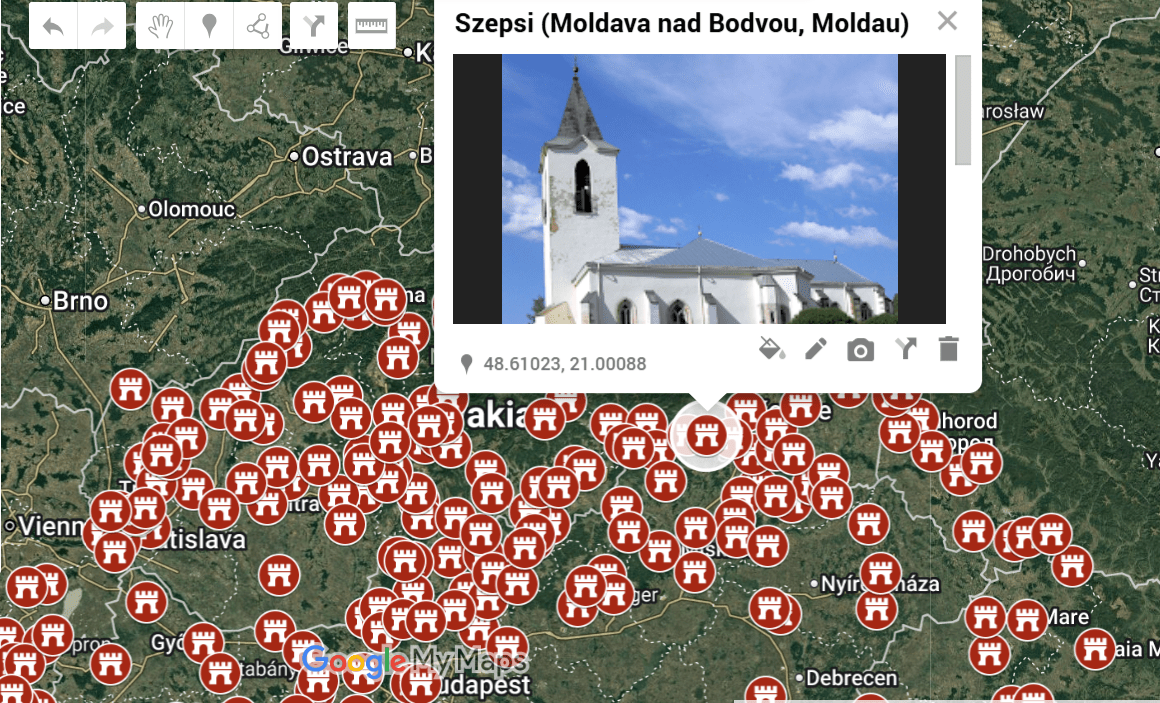


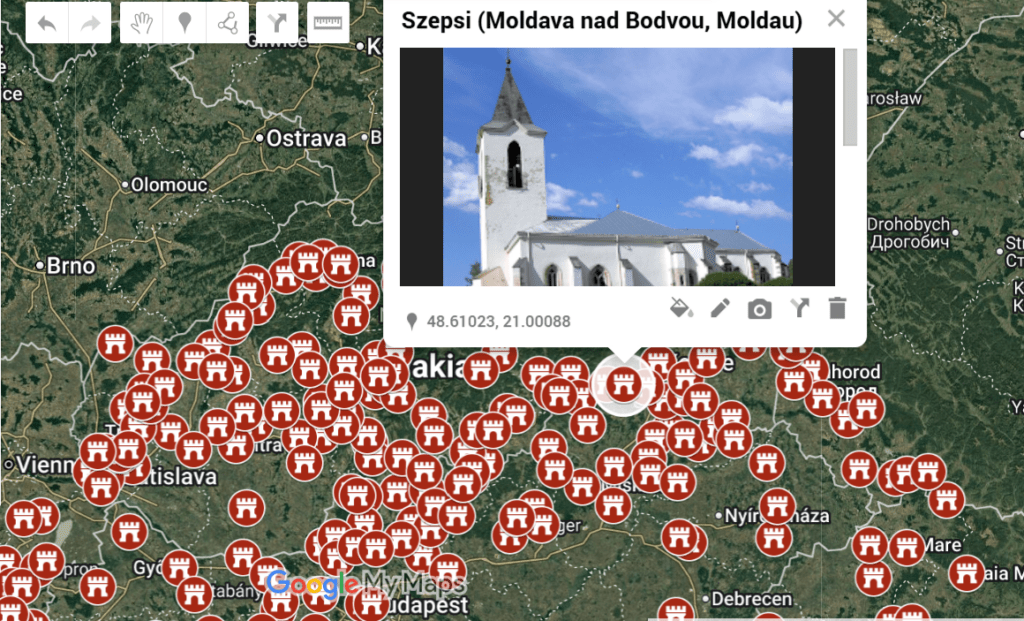
Szepsi (Moldava nad Bodvou, Moldau) is a town in Slovakia. It is famous for its once fortified church was built in the Kingdom of Hungary in the 13th century. It is located 26 km southwest of Kassa/Košice, on both banks of the Bódva River, along the international road leading to Rozsnyó. This is where the Kassa Basin ends, and the diverse Gömör-Tornai karst region begins.
Location on my Google Map: https://tinyurl.com/se6hxfju
The town of Szepsi was founded by Saxons from Szepes who settled here after the Mongol invasion. However, it is also possible that it existed earlier and was destroyed during the Mongol invasion (the nearby monastery in Jászó was also burned down). In 1255, in a charter issued by King Béla IV to the monastery in Jászó, Zekesres (Szekeres, Szepsi) is also mentioned as a border town where the royal carriage drivers lived. On March 30, 1282, King László IV appointed Leonard of Szepsi as royal falconer in a charter issued here.

The church was probably built in the 1280s. On December 21, 1290, a charter issued by King András III mentions its parish priest. In June 1294, King András III had several of his charters issued from Szepsi. According to a document from 1317, the town of Szepsi was governed by a town council headed by a judge.

The settlement appears in a charter issued by King Károly I in 1323 under the name “civitas nostra Scepusi/Scepusy.” In the 1330s, the papal tithe collector recorded that there were 125 settlements surrounded by stone walls with churches in Abaúj County at that time. In 1330, the parish priest of Szepsi, László, was mentioned by name for the first time. He was followed by János (1345-51) and then Jakab (1351).

In 1330, Drugeth Fülöp, chief Comes of Abaúj, brought settlers to Bodolló, which had been “owned by the church of Szepsi since time immemorial.” In 1331, the judge of Szekeres/Szepsi (“Szekeres seu Sepesi”) was called Tatár Ewuchmannus. Szepsi paid 96 garash at that time (Kassa paid 552 and Gönc paid 107).

At the end of the 13th century and in the 14th century, the town of Szepsi was involved in numerous lawsuits with the provostry of Jászó. In 1340, the Rozgonyi family is mentioned as the landlords of Szepsi, but they did not control the entire town. In 1387, the Kapolyi family is mentioned as the landlords, but the town is still referred to as a royal settlement. In 1391, Nikolai János was the parish priest of Szepsi.

After King Albert’s death, Queen Elizabeth brought Giskrá of Brandisi into the country to protect the interests of the infant King László V. Giskrá was constantly at odds with Hunyadi János, which often resulted in armed conflict. In the spring of 1449, Giskra invaded Zemplén and captured several castles. In September, Hunyadi sent Székely Tamás to stop Giskra, but Székely suffered defeat at the hands of the Czechs at Somodina.

Giskra occupied Szepsi, fortified the church, and stationed a garrison there. A month later, Governor Hunyadi János routed the Czechs from the church castle and had the captured Czech and Polish mercenaries mutilated as a deterrent. On October 28, Governor Hunyadi János sent a letter from Szepsi Castle and then had the fortifications demolished. In 1451, the Hussite Thalafus captured Szepsi. The archives of the city of Kassa contain a letter dated June 27, 1451, according to which Thalafus occupied and fortified the church. In 1452, Hunyadi János once again drove the Czech robbers out of the city.

In 1480, King Matthias’s charter mentions it as an oppidum called Scepsi or Zekeres. During Matthias’s reign, the church was rebuilt in Gothic style, and its 283 cm high south gate, which can still be seen today, imitates the cathedral in Kassa/Košice.

In 1554, Benedek, the parish priest of Szepsi, converted to the new faith along with most of the population. By 1558, the church belonged to the Reformed Church. The church burned down in 1567 and again in 1580. An entry in the Sárospatak chronicle from 1592 states that the church in Szepsi was surrounded by a stone wall.

In 1599, fleeing from the Tatar-Turkish armies, Basta fled from Szepsi to Kassa with his troops and cannons. In 1644, the armies of Palatine Esterházy Miklós marched through Szepsi and attempted to seize the church from the Reformed community. They did not succeed, but the mercenaries burned down the church and the rectory. The citizens of Szepsi asked Prince Rákóczi György I of Transylvania for help. The prince supported the students of Szepsi in studying at foreign universities.

During the Counter-Reformation, the church changed hands several times. In 1705, on the orders of Prince Rákóczi Ferenc II, it was returned to the Protestants, and this was confirmed by Emperor Joseph I in 1709. In 1711, on the orders of the widowed empress, it was returned to the Catholics.

On August 27, 1794, a huge fire ravaged Szepsi, destroying the church. The building stood without a roof for nearly ten years, and its condition deteriorated rapidly. A nationwide collection was launched for its reconstruction, and during the renovation, the former three-nave Gothic space took on a single-nave Baroque form, with 12 Doric columns supporting the nave’s vault. Only the sanctuary and the south gate remained from the Gothic era.

The Szojka Gate is a Székely gate, the only monument that survived the fire of 1795. Almost everything in the town burned down; only the walls of the churches remained. Miraculously, the gate also survived, albeit slightly charred. The Latin inscription “I burned, I burned, but I did not burn down…” commemorates the event. A replica was erected in 1996 in the park next to the Reformed church, not far from its former location, in front of house no. 33 on Fő Street. The original gate is located in the courtyard of the East Slovak Museum in Kassa/Košice.

In 1854, the interior of the church burned down, and in 1895/96, the building was completely renovated. The Neo-Gothic main altar was also built at this time. It was renovated again in 1936. In 1945, the retreating Germans blew up part of the church tower. This was rebuilt in 1966. In 1980, the damaged bells, which had been hidden during the war, were recast. In 2010, the sacristy and sanctuary were renovated.

Important figures born in the town:
Master Simon taught at its school in 1458, and a plaque on the school wall preserves his memory. Szepsi Korótz György, secretary to Prince Bocskai István and later a teacher and preacher, was born here. Historian and poet Szepsi Máté Laczkó was born here in 1576, who later entered the service of Lorántffy Zsuzsanna and Prince Rákóczi György I. He was active in literature as a historian and poet. Nevertheless, his most famous creation is Tokaji aszú, which he was the first to produce and served at his mistress’s table for the first time in 1630. Aszú is still made today according to his recipe.

Szepsi Csombor Márton, a traveler, was born here in 1595. He was the author of the first Hungarian-language travelogue, Europica Varietas, and later became a member of the Strasbourg Academy.
Population:
In 1910, 2,163 of its 2,197 inhabitants were Hungarian. The population ratio has reversed in the last ten years; in 1991, it was still a Hungarian-majority settlement. In 2001, it had 9,525 inhabitants, of whom 4,847 were Slovak, 4,158 were Hungarian, and 353 were Roma. In 2011, out of 11,068 inhabitants, 4,683 were Slovak, 3,279 were Hungarian, 1,085 were Roma, 30 were Czech, and 1,942 were of unknown nationality.

In 2021, out of 10,305 inhabitants, 5,399 were Slovak, 2,897 were Hungarian (28.1%), 1,574 were Roma, 28 were Czech, 20 were Ukrainian, 12 were Ruthenian, 6 were German, 3 were Polish, 1 was Moravian, 1 was Vietnamese, 1 was Bulgarian, 1 was Austrian, 1 was Irish, and 8 had an unknown nationality.

Source: https://varlexikon.hu/szepsi-templom Szöllősi Gábor, and the Hungarian Wikipedia page
Dear Readers, I can only make this content available through small donations or by selling my books or T-shirts.
Please, support me with a coffee here: https://www.buymeacoffee.com/duhoxoxa
You can check out my books on Amazon or Draft2Digital. They are available in hardcover, paperback, or ebook:
https://www.amazon.com/dp/198020490X or at https://books2read.com/b/boYd81
My work can also be followed and supported on Patreon: Become a Patron!http://Become a Patron!
Become a Patron! Donations can be sent by PayPal, too: https://tinyurl.com/yknsvbk7

https://hungarianottomanwars.myspreadshop.com/all
Subscribe to my newsletter here: https://tinyurl.com/4jdjbfkn
Here are more pictures of Szepsi: