“Hussars, follow me!” – How a Hungarian regiment became heroes
An entire Hungarian hussar regiment charged the Russian overwhelming force with rifle butts, clubs, and bare fists. Many of them remained on the battlefield, but they were victorious at Limanova in 1914.

The first year of the “Great War” unfolded very tragically for the Austro-Hungarian Monarchy. Although the Serbs had been pushed back by November, in the north, the Russian invasion, or as it was called then, the “Russian steamroller,” seemed unstoppable. By the end of November, the Tsarist armies had reached the Carpathians. By December 1914, the situation threatened that if the Tsarist forces broke through the Austro-Hungarian defenses near Krakow, they would invade Hungary. From there, they would have had a clear path to Budapest, which would have been followed by the Monarchy’s surrender.
That this did not happen was largely thanks to the 10th Cavalry Division, and among them, to the Nádasdy Hussars composed of lads from Sopron – this was the Battle of Limanowa (in Hungarian: Limanova).

Communism erased their memory, but the Zrínyi Military Film Studio is reviving the most outstanding Hungarian feat of heroism from the First World War with a 60-minute documentary. Contemporary sources, photographs, on-site footage, battle scenes reenacted by military tradition-keepers, and over a year and a half of historical research make the production unique. Yet its greatest value may still be the “main protagonist,” the elderly Ujhegyi János, whose testimony—based on stories passed down to him by his father, Ujhegyi Béla, a survivor of the battle—sheds light on the human side of war. The humanity within the hero.

But let us begin at the beginning, as the film does. Bárány Krisztián, the writer and director of the film Halhatatlanok – Limanowa, a magyar győzelem 1914 (Immortals – Limanowa, Hungarian victory in 1914) and the head of Filmlab, was interviewd about the battle.
They Charged with Swords into Machine Gun Fire
The cavalry, as a branch of the military, had become quite obsolete by the beginning of the 20th century. However, the Austro-Hungarian high command did not acknowledge this until the machine-gun volleys had cut serious gaps in the ranks of our hussars. They were not afraid, they did not retreat; at the beginning of the war, they charged sword-drawn into the heart of enemy fire with a Hungarian virtus (“valor”) that even earned the enemy’s admiration. As with the death charge at Gorodok on August 17, 1914:
When the Hungarian cavalry reached Gorodok, it deployed into battle formation in close order and, without reconnaissance, heedless of everything, charged in this tactically unsuitable formation upon our infantry. The lively fire of our artillery, followed by infantry volleys, met this insanely brave but reckless assault.

Count Keller, also an eyewitness and a Russian dragoon lieutenant, recalled that the blood ran cold even in the enemy at the sight of the Hungarian charge.
The cavalry charge collapsed within minutes, and the magnificent hussar troop, which moments before had been galloping forth, now lay tangled upon one another, writhing, screaming, and dying.
Such heroism and such breathtaking recklessness had not been seen even by our oldest soldiers who had fought in multiple wars. Everyone was stunned. Several of the officers directing the machine guns broke down in tears…
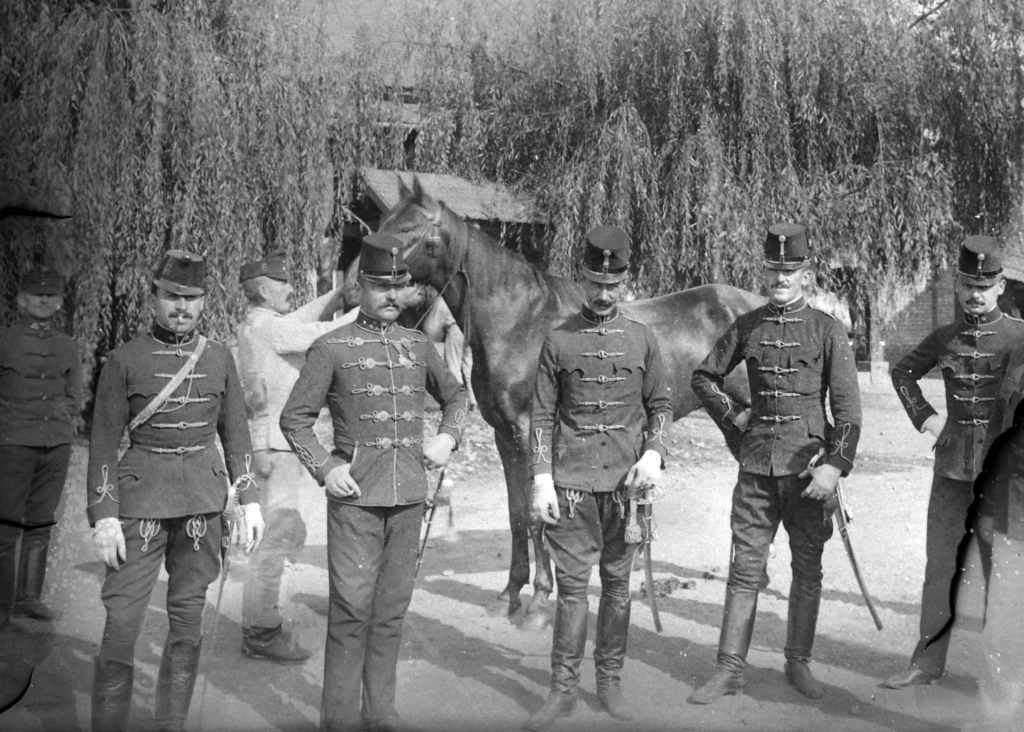
When the battered enemy cavalry retreated, we all hurried to the wire entanglements to bandage the wounded and bury the dead. However, the wounded hussars could not be approached because they propped themselves up and fired at us. The wretched souls had to be destroyed one by one…
“Five hundred men and 650 army horses remained on the ground, an entire regiment. Such were the Hungarian hussars…” wrote Russian General Alexei Alexeevich Brusilov.
“An ‘Obsolete’ Yet Elite Branch of the Military”
However, the Imperial and Royal high command also learned from this. From then on, the primary task of the cavalry was deep reconnaissance and raids; they launched frontal attacks dismounted from their horses. For the latter, they were not even properly equipped: they lacked, for example, bayonets and infantry shovels. Yet they fought in such a way that the famous—or infamous—Russian Cossacks feared the Hungarian hussars, referring to them as red devils.

Let us not forget that no matter how much technology had surpassed this mode of combat, we are talking about an elite unit whose legendary cohesion perhaps granted even greater strength than their excellent and thorough training: the officer was a father, the soldier a son, the comrade a brother, the horse a companion.

Let us return to Limanova. In the area around the town located south of Krakow, the relentless, strong pressure from the Russian left flank threatened to collapse the right wing of the Austro-Hungarian defense. The frontline units of the 10th Cavalry Division were relieved twice daily, thus ensuring some rest for the exhausted soldiers.
They Sacrificed Themselves. Without a Second Thought
On the dawn of December 11, 1914, the 9th “Nádasdy” Hussar Regiment under the command of Colonel Ottmár Muhr appeared on a strategically vital hilltop to relieve those fighting there.

A horrific sight greeted them. Most of the defenders were dead, only a handful of infantrymen were holding the line, and it was clear: a Russian breakthrough was a matter of hours, perhaps minutes. The colonel had to decide quickly and alone what to do—he had no orders to attack. But he was an excellently trained, talented hussar officer for a reason. Ottmár Muhr assessed the situation in an instant and shouted:
“Hussars, follow me, hussars forward! Come on, boys!”
And at the head of the regiment, he began to charge the Russian forces, who had twice their numbers. On foot. His men eagerly followed him with nothing but their carbines, having left their swords behind with the horses, as they had nothing else. No bayonets either—since those were not part of the hussars’ armament at the time. They fired the five rounds from their carbines, then used the weapons as clubs to engage in close combat. Some attacked the enemy with sticks, and later with their bare fists.

The writer Molnár Ferenc, who inspected the battlefield the next day as a war correspondent—and was deeply shaken by what he saw—wrote this:
“I could hardly see any gunshot wounds on the Russians. Their incredible momentum swept along even their comrades who had lost hope from the trenches, and a general attack unfolded. With rifle butts, sticks, and fists, but with such determination and wild fury, as if they were not from this world. The deeply beloved and respected Ottmár Muhr, whom the men only called ‘Uncle Muhr,’ received a mortal wound.
At such times, the momentum ‘usually’ vanishes; with the fall of the leader, the soldiers’ courage dissipates, and the charge turns into a retreat—history offers countless examples of this. But this only enraged the hussars even more. They carried the colonel’s body to a safe distance, and while spurring each other on, they chopped up the enemy with renewed strength. And the enemy could not hold out for long: they slowly retreated, then fled. What did the Cossacks call them? Red devils…”
Fighting Like Lions
“I was in hell,” Ujhegyi Béla later told his son. In the 1960s, he suffered a stroke and was taken to the hospital. There, half a century later, the horrors burst out of him: at night, he would stand up in bed, gesticulating, shouting, and had to be sedated with injections. His son János told him he must have been reliving the nightmarish pressure of the war. The old hussar smiled: “That cannot be experienced again.”

The victory was Pyrrhic; a contemporary eyewitness put it this way: there was a hussar regiment fighting in the battle, but there is no longer one; it remained on the battlefield, having fought like lions. But with the victory at Limanova, the danger that the Russians would break through and outflank the Austro-Hungarian left wing was averted, and with it, the likely decisive outcome of the entire war.
On the battlefields of the First World War, Hungarian units can be found almost everywhere, and numerous successes are linked to their names. However, this, the Battle of Limanova, is the most significant and truly the only victorious battle carried out exclusively by Hungarians – emphasized Bárány Krisztián. Its memory was fittingly honored; the Nádasdy Hussars had a veritable cult in Hungary until 1945.
Immortals
Then, during the communist era, they were denied, concealed, and forbidden. In the ’50s, unknown persons even smashed the memorial containing the names of the heroic dead into pieces one night. Only the families carried on their memory in whispers, in secret, but it has completely faded from public consciousness today.
However, the Poles did not forget. Around Krakow, throughout Galicia, Ottmár Muhr and his hussars are known and respected. A beautiful mausoleum was erected for the colonel, and even on the graves of the common hussars, there is always a fresh flower or a candle burning.

The cult of the Hungarian hussars still lives on there, yet in our homeland, very few people know the story. The documentary also strives to make the story of the Battle of Limanova, the events of the first months of the “Great War,” more widely known. During this period, the Austro-Hungarian Monarchy lost nearly one hundred thousand soldiers on the Eastern Front alone – said Bárány Krisztián.
Limanova is an important milestone in Polish-Hungarian friendship, when the Hungarians saved their neighbors from the eternal enemy, the Russians. This makes it understandable why Bárány Krisztián called them “immortals” in the film’s title. The historian writer-director quotes the final thought from a hussar first lieutenant’s memoirs:
Through the eternity of time, your simple, small graves will proclaim Hungarian self-sacrifice. You are superhuman heroes, who, with your deaths in the Battle of Limanova, purchased immortality.
Author: Bihari Dániel

The report was made in 2017. Since then, the film has been completed. I warmly recommend watching it! The film is available with English subs here:
https://www.youtube.com/watch?v=7Id4SryH0Dk
Here is another video of the Digitális Legendárium as well, it also has English subtitles:
https://www.youtube.com/watch?v=zNWvcLaGEzo
An afterthought:
Colonel Ottmár Muhr was posthumously granted Hungarian nobility with the predicate “limanowai” for his self-sacrificing heroism, rightfully earning the Knight’s Cross of the Order of Leopold with Swords and War Decoration and the Officer’s Golden Medal for Bravery. Of his four sons, two—Albert and Győző—followed in their father’s footsteps, serving as hussar officers in the post-1920 Royal Hungarian Honvéd Army. Albert died a heroic death on September 13, 1941, near Tomakowka in Ukraine, as the commander of a dismounted hussar squadron of the 3rd “Nádasdy Ferenc” Honvéd Hussar Regiment from Nagyvárad. A certain Captain Szántay also died at Limanowa, I don’t know whether he was related to my Szántai family or not.

Dear Readers, I can only make this content available through small donations or by selling my books or T-shirts.
Please, support me with a coffee here: https://www.buymeacoffee.com/duhoxoxa
You can check out my books on Amazon or Draft2Digital. They are available in hardcover, paperback, or ebook:
https://www.amazon.com/dp/198020490X or at https://books2read.com/b/boYd81
My work can also be followed and supported on Patreon: Become a Patron!http://Become a Patron!
Become a Patron! Donations can be sent by PayPal, too: https://tinyurl.com/yknsvbk7

https://hungarianottomanwars.myspreadshop.com/all
Subscribe to my newsletter here: https://tinyurl.com/4jdjbfkn