


Szulyóváralja (until 1899 Szulyó-Hradna, in Slovak: Súľov-Hradná) is a village in Slovakia, located in the Zsolna (Žilina) Region, in the Nagybiccse (Bytča) District. It was built in the 13th century during the Kingdom of Hungary. Location on my Google Maps: https://tinyurl.com/52ht47st
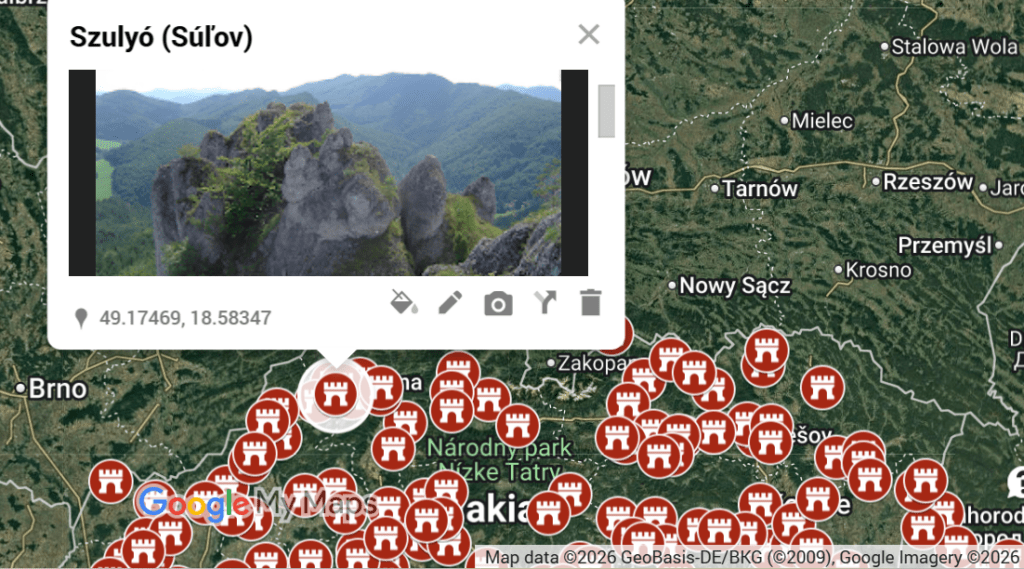
Approximately 1.5 km from the village of Szulyóváralja, on one of the rock formations of the Szulyó Rocks, lie the ruins of Szulyó Castle. It is perhaps one of the most interesting and most romantically wild castle ruins in the Carpathian Basin; however, very few historical sources are available about it.

The time of the castle’s construction is uncertain. In 1976, Ondrej Sedo found 13th-century pottery shards in the castle’s debris layer. Hradna and Szulyó belonged to the noble castle warriors (“várjobbágy”) of Trencsén (Trenčín), and it is possible that they built the castle during the period of the Mongol invasion. According to a charter of King Béla III from 1193, Szulyó (“Sulo”) was the property of Vrazlo (Vratislav), a castle warrior of Trencsén. In this charter, the king grants the village to his Trencsén castle warrior named Vratislav, along with other estates, for his services in the Dalmatian wars. Although there is no documentary evidence, it is likely that Szulyó also came into the possession of Csák Máté, along with the other castles of Trencsén, after 1300.

The first known record of the castle dates from 1336 (“Sculyo, Sculio”). At that time, the ancestor of the Szulyó family, Illés (Elijah), son of Máté (Matthew) of Hodász, castellan of Budetin, requested it from the king for himself. On March 19, 1337, King Charles I (Charles Robert of Anjou) made it known that Magister Illés, son of Máté of Hadaz, castellan of Budetin, had requested the estate of Sculyo in Trencsén (Trenčín) County in recognition of his services, which had belonged to a noble castle warrior of Trencsén Castle who had died without heirs.

In 1440, Miklós (Nicholas) of Swidergal, castellan of Budetin, seized it for King Ulászló (Vladislaus) I. On June 4, 1470, King Matthias Corvinus granted permission to the Szulyó family to fortify their stronghold called Rohács (“castellum seu fortalicium Rohach”) with a moat and towers (gallery). Researchers generally interpret this record as referring to the castle. Still, Koppány Tibor raises the possibility that Illés, son of Péter (Peter), received permission to reinforce the manor house situated below the castle.

In the 1536 tax register of Trencsén County, the following entry appears: “The magnificent lord, Kozka Miklós, on account of the provisioning of the castle called Szulyó, as he says, has retained for himself the assets of his castles. (Magnificus dominus Nicolaus Kozka ratione provisionis arcis Swlyow vocatae, ut dicit, retinuit pro se in bonis arcium suorum)”.

The castle was also in the possession of the Szulyovszky, Hradnyánszky, and Szirmay families. In 1546, it was in the possession of the Podmaniczky family, who were the lords of Vágbeszterce (Považská Bystrica) Castle. At that time, besides the judge, five taxable households were counted, with five free families and two poor families living here, and it also had a mill.

With the death of Szulyó György without an heir in 1550, Szulyó Castle passed to the crown. King Ferdinand I granted it to Syrmiensis Sebestyén (of Szerém), but the formal installation on December 29, 1550, was prevented by Rozsony Pál, an agent of Podmaniczky Rafael. They attacked the castle and set it on fire. Syrmiensis was forced to enter into litigation with Podmaniczky; according to the Trencsén tax register of 1553, it was most likely already in his possession. Sebestyén had the burnt-out castle restored, and his descendants adopted the name Szulyovszky. On July 17, 1576, Archduke Charles requested a report from the Hungarian Chamber of Commerce as to whether Szulyó Castle was still in the possession of Szerémi Sebestyén, the secretary of the Hungarian Chamber.

Between 1592 and 1594, a manor house fortified with corner bastions was built in the village. In 1598, the settlement had 45 houses. Its Lutheran church was built in 1616, at which time it was one of the earliest Protestant churches in Upper Hungary (the historic Hungarian region now largely corresponding to Slovakia). In Szulyó, there are two Renaissance manor houses, which were built between 1592 and 1594, and between 1603 and 1608, respectively.

In 1682, Bossányi Katalin, the widow of Szulyovszky Zsigmond, wanted to rebuild the dilapidated castle, but with her death, the work came to a halt. During the Rákóczi War of Independence (1703–1711), Szulyovszky Gáspár repelled a Kuruc (Hungarian rebel) attack.

Later, the church became an articular church, one of those that were allowed to remain in the possession of the Lutheran church during the Counter-Reformation. However, in 1711, it was nevertheless taken over by the Catholics and has been the property of the Catholic Church ever since. In 1784, the village had 70 houses with 400 inhabitants.

At the end of the 18th century, András Vályi wrote the following about it:
“SZULOV, or Szulyov. A Slovak village in Trencsén County. Its landowner is the noble Szulyovszky family. Its inhabitants are Catholics and Lutherans. It lies below Rohács Castle. Its soil is poor.”

In 1752, a survey mentioned the castle’s kitchen, scullery, as well as its residential and ceremonial rooms. When the Szulyovszky family left the castle, it was still guarded by two watchmen until 1780, but after that, it became completely abandoned. A depiction from the end of the 18th century shows the castle without a roof, but the walls of most of the buildings were still standing at their original height. In 1858, many of its standing walls collapsed as a result of an earthquake.

Könyöki József surveyed and drew Szulyó in 1882:
“…In the center of this rock group, as if it were a part of it, stands the castle ruin, which is not large in extent but is extremely interesting. Since the castle dominates only the narrow valley set back from both the Vág River and the highway, it could not have had any influence on the defensive system of the Vág Valley, and thus it can be regarded as a private castle.

King Ferdinand I bestowed this castle upon Szirmíensis Sebestyén with the predicate “of Szulyó,” because he had defected to him with his 50 horsemen during the siege of Vienna in 1530. In 1531, his son Leonardus took over the castle; Leonardus became deputy Comes of Trencsén County in 1589. His grandson, Theodosius, was also deputy county head and took over the castle in 1593. In 1610, he also served as a royal associate justice of the Royal Court, and on January 7, 1611, he was also a member of the Palatine’s court that sat in Biccse (Bytča) to try the infamous case of Báthory Erzsébet, the widow of Nádasdy Ferenc, for her crimes at Csejte (Čachtice).

In 1650, the castle became the property of Zsigmond, the grandson of Theodosius. His widow, Katalin, born in Bocha, converted the castle in 1682 with royal permission and gave it the name Katalinvár (Katherine’s Castle). However, the conversion work was never completed because after her death, her son and heir, Gáspár, did not continue it. This Gáspár, heroically defending the castle against the Rákóczi forces, was confirmed in his possession of the estate and even received a letter of commendation from Field Marshal Baron Bergami László. After his death, the castle came into the possession of his son of the same name, who was a councilor of the city of Pozsony (Bratislava). He abandoned the castle, and it gradually began to decay, so that now only a few damaged walls remain, and reaching them is not without danger.

As for the description of the castle, I take the liberty of noting the following. Upon entering the Szulyó valley, a steep rock face stands before us on its northern side. Circling this rock face, we reach the northern side of the castle, where we find the entrance (1) among the high rock peaks. The adjacent room (2) was a watchtower. From here, proceeding steeply upward along a narrow rock, we reach the path (3), which leads to the southeastern side of the castle. The wall visible there only secures the approach. Crossing through the gate, which is protected on the eastern side by a half-roundel, we arrive via the narrow path (4) at a tunnel carved into the rock, which leads to the rooms (5, 6, 7, and 8).

“Rooms 5 and 6 are still vaulted with barrel vaults. However, the upper floor of these rooms cannot be determined. Courtyard 9 could only be reached from the first floor of room 7. This, together with roundel 11, defended the western side of the castle. At 10, we see the water cistern. The walls are constructed partly of stone, partly of brick, but I cannot determine whether there is any marking on the bricks, as I was unable to examine the whole masonry. The vaults are made of tuff stone. I found no carved stone. The coat of arms shown on the attached sheet is that of the Szirmiensis family, and I found it on a portrait of Theodosius, which belongs to the landowner Mrs. Badnai Madocsányi. This branch of the Szulyovszky family, still living in Szulyó, was never the owner of the castle.”

Divald wrote the following about the castle in 1905:
“On one of the triple cliffs of the fantastically beautiful, rocky Szulyó valley, a semicircular courtyard with cylindrical bastions on the enclosure wall; in its southeastern corner, the ruins of a smaller stone house, consisting of three rooms on the ground floor and three on the upper floor.”

As for today, the castle ruins are situated on three rock masses and the narrow rock plateau below them. Its total area is approximately 70 by 30 meters, with a height difference of 18 meters between the highest and lowest points. The walls were positioned to adapt to the terrain conditions. The oldest part of the castle was built on top of the southern rock. Initially, this consisted of a watchtower and a small courtyard, with a rainwater cistern carved into the rock. As a result of an expansion, it was extended with a building attached from the east, which was integrated into the rock formations that form a significant part of the walls.

The ground-floor rooms were barrel-vaulted, and one of them led to the entrance leading to the upper part of the castle. Stairs carved into the rock led to the gate, which was flanked by an oval tower that projected from the main building mass. To the north of the small eastern castle courtyard, there were further rooms.
To the north, the gap between the two rock peaks was closed off with a wall, and buildings stood on top of them. Remains of an arched vault can still be seen on the northeastern peak. At the foot of the northwestern rock lie the ruins of a multi-story building. In recent years, the work of enthusiastic volunteers has saved the crumbling parts of the castle.
Source: https://varlexikon.hu/szulyo-var Szöllősi Gábor

Dear Readers, I can only make this content available through small donations or by selling my books or T-shirts.
Please, support me with a coffee here: https://www.buymeacoffee.com/duhoxoxa
You can check out my books on Amazon or Draft2Digital. They are available in hardcover, paperback, or ebook:
https://www.amazon.com/dp/198020490X or at https://books2read.com/b/boYd81
My work can also be followed and supported on Patreon: Become a Patron!http://Become a Patron!
Become a Patron! Donations can be sent by PayPal, too: https://tinyurl.com/yknsvbk7


https://hungarianottomanwars.myspreadshop.com/all
Subscribe to my newsletter here: https://tinyurl.com/4jdjbfkn
Here are more pictures of Szulyó Castle:


