


Jolsva (Slovak: Jelšava, German: Jelschau/Eltsch, Latin: Alnovia) is a town and mining center in Slovakia, located in the Banská Bystrica Region, within the Revúca District. Jolsva was founded as a mining settlement in the 13th century within the Kingdom of Hungary. It is first mentioned in 1243 as “Ilswa,” but its first wooden castle had already stood before the Mongol (Tatar) invasion. The settlement was established by German miners who were brought here to work the local iron and lead mines.
Location on my map: https://tinyurl.com/mu3dsdyp
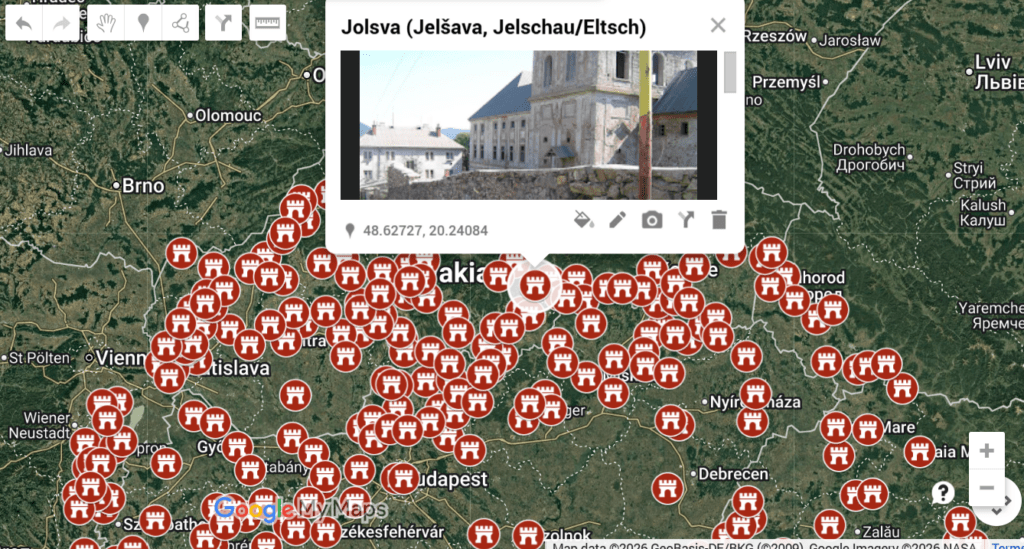
The most important point is that two different fortifications stood on and near the site of the Coburg-Koháry Mansion before the 16th century: an early royal castle and a later noble castle, built in the Kingdom of Hungary. So, the history of the mansion going back to the 16th century is linked to a monastery and a Renaissance manor house, while the ruins on the hill above the town preserve the memory of the much earlier 13th–15th-century castles.

The 13th-century royal castle:
The town’s history is closely intertwined with the mining carried out here. Iron, lead, gold, and silver were all mined in the region.
First mention:
The town (and presumably a fortress as well) was first mentioned in 1243 under the name “Ilswa”.
Purpose and fate:
This earliest castle was probably built on royal initiative to protect the valuable mining region. It is assumed that a wooden fortification may have stood here even before the Mongol invasion (1241–42). However, sources indicate that this castle had already been abandoned by 1271, most likely losing its importance due to the construction of the nearby Murány (Muráň) Castle.

The 14th-century Jolsva Castle:
The castle ruins visible today are not those of the 13th-century fortress, but the remains of a later stone castle, located on a forested hill northwest of the town.
Builder of the new castle:
The Jolsvai family of the Rátót clan (who had held the region since 1327) most likely built it in the second half of the 14th century. One member of the family, Palatine Leusták, also owned the castle and lived in its heyday in the last third of the 14th century.

First mention and significance:
This new castle was first mentioned in written sources in 1421. At that time, it was one of the centres of the region, and the family administered the Murány estate from here. During the reign of King Sigismund, the nearby town of Jolsva became one of the important trading centres of the Kingdom of Hungary, which further increased the castle’s importance.
The destruction of the castle in the 15th century:
The castle’s fate was sealed in the mid-15th century by the Hussite wars. In the 1440s, the Hussites captured the castle, and soon after it was destroyed. The condition was so severe that by 1453 it is mentioned as a ruin in the sources.

After the castle’s destruction, the market town of Jolsva became the centre of the estate. Although minor restoration works were still carried out in the second half of the 15th century (for instance, under the Perényi or Bebek families), the castle never regained its former significance. By the 16th century (specifically by 1566), Ottoman devastations had finally ruined the region and the castle’s remains as well.

The present-day Classicist Coburg Mansion is not identical to these medieval castles. This building was constructed on the foundations of a 16th-century Renaissance structure, which itself had been built on the site of an earlier, presumably Pauline monastery.

The mansion was damaged and looted by troops passing through during the uprisings of Thököly Imre and Rákóczi Ferenc II. After 1711, Koháry István began repairing it. The current building was added to an older Renaissance structure from the mid-16th century. According to tradition, a Templar monastery originally stood on its site. The main façade, facing the square, is articulated with pilaster strips and a prominent three-bay risalit, crowned by a gable with a tympanum. On it is a relief of military trophies with the initials MK, standing for Miklós Koháry.

The castle was built by the Koháry family, who were considered a prominent Hungarian noble family. Later, it came into the possession of the famous Coburg family, after Koháry Mária Antónia married Prince Ferdinand of Saxe-Coburg-Gotha. The building once served as the family’s estate center in the Jolsvá (now Jelšava) region, functioning both as an economic and cultural hub.

The castle was once surrounded by an English park and was renowned for its library and valuable furnishings. The Coburgs did a great deal to develop local industry, particularly iron processing. During the 20th century, the castle was nationalized and subsequently used for various purposes—such as a school. Today, the building is partly under renovation, and there are efforts to restore its touristic and cultural role. The once-luxurious castle is now a historical landmark that evokes the aristocratic past of the region. The history of the castle is closely intertwined with Hungarian and Slovak history.

Now, the mansion bears the name of its last owners – the noble Coburg family. During their tenure, the Directorate of the Coburg Forest Estates was based here. The Coburg Castle monument building (Koháry Castle) is currently under reconstruction. After an agreement is reached, tours can also be arranged. In cooperation with the civic association Čierne diery (Black Holes), a unique experience hotel is being built at the highest point of the castle. It will be available in 2022.

Dear Readers, I can only make this content available through small donations or by selling my books or T-shirts.
Please, support me with a coffee here: https://www.buymeacoffee.com/duhoxoxa
You can check out my books on Amazon or Draft2Digital. They are available in hardcover, paperback, or ebook:
https://www.amazon.com/dp/198020490X or at https://books2read.com/b/boYd81
My work can also be followed and supported on Patreon: Become a Patron!http://Become a Patron!
Become a Patron! Donations can be sent by PayPal, too: https://tinyurl.com/yknsvbk7

https://hungarianottomanwars.myspreadshop.com/all
Subscribe to my newsletter here: https://tinyurl.com/4jdjbfkn
Here are a few more pictures of the Mansion:


