
The Role of Habsburg Ferdinand, Miklós Jurisics, and the Croatian Estates in Connection with the Battle of Mohács…
Let me share the thoughts of a Hungarian historian, Botlik Richárd, with you.
Five hundred years ago, on 4 August 1526, a document was issued which, evidently, will not be used by the historian colleagues dealing with the Battle of Mohács. I, however, will do so now, so that it (too) does not fall into oblivion. A small addition to the history of the defeat at Mohács.
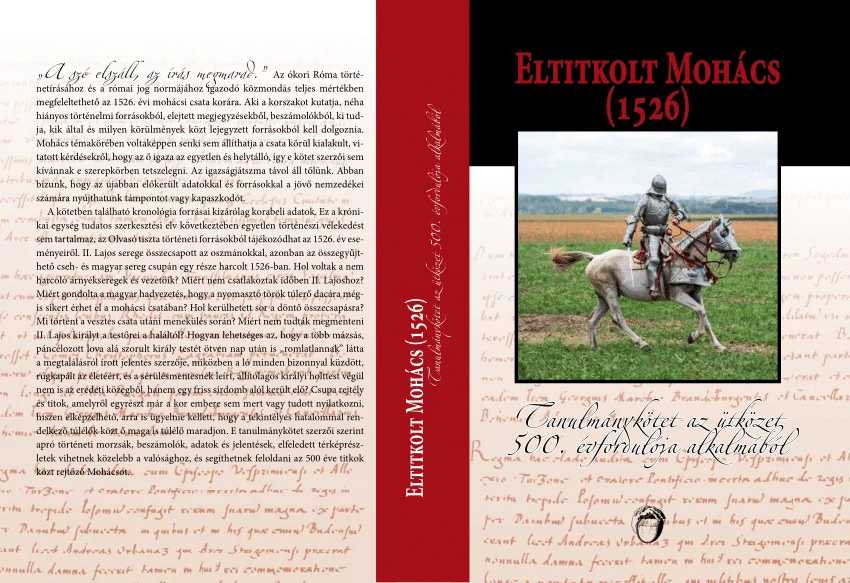
There is a certain document in the Viennese archives which, clearer than the sun, reveals that insidious, calculating, and furtive relationship that could already be sensed in the air from the spring of 1526. Even then, the Croatian Estates were wavering, as reported by Nuncio Burgio, who was in Buda, on 27 March: “The Croats are negotiating now with the Turks, now with Archduke Ferdinand of Austria.” (TNA. PRO. SP1. 37. f. 223. Mohács emlékezet, 1979. pp. 194-196.)

Then, Habsburg Ferdinand – to prevent the Croats from allying with the Turks – organised a private army in Croatia, the salary for which was paid monthly by the Lower Austrian Chamber. When Ferenc Batthyány, the Ban of Croatia-Slavonia-Dalmatia, sent word to the spring Diet of Rákos that they were already preparing for the fight against the Turks, he promised 11,000 men to King Louis II. Later, however, the cold shower arrived: although Batthyány asked the Croatian Estates to join the royal camp, only a few of the Croatian lords went to the Battle of Mohács (the Erdődy brothers, Orlovics, Josefics, and Zrínyi were there, but the entire contingent was no larger than a thousand men).

Batthyány was only able to recruit 4,000–4,500 Slavonian soldiers, which means that about 5,000–5,500 Croats watched idly as the Kingdom of Hungary suffered defeat at Mohács. Among them was Kristóf Frangepán, who in his letter dated 5 September labelled the Hungarian defeat at Mohács a “useful blow.” (ÖStA. HHStA. Ungarische Akten Allgemeine Akten Fasc. 2. Konv. B. 47-53.)

And the document issued on this very day 500 years ago, whose reference number in the Viennese archives is: ÖStA. HHStA. Ungarische Akten Allgemeine Akten Fasc. 2. Konv. E. 14–15. Its content: Archduke Habsburg Ferdinand, from Vienna, asks Miklós Jurisics to keep the Croatian frontier troops in his pay, as their defence against the Turks is important for Austria. The governor calls upon the troops of the Croatian Estates not to leave their posts. If they nevertheless do so and join the Hungarian army of King Louis II, then it is the duty of the Hungarian king to replace the missing men and to pay their wages to Ferdinand.

What does all this mean? Since 1102, the Kingdom of Hungary has been in a personal union with Croatia. What business does an Austrian have in Hungarian-Croatian internal affairs? Since 1515, the Habsburg-Jagiellonian treaty has been in effect, meaning that if King Louis II of Bohemia and Hungary dies in 1526 (and has no lawful heir), Habsburg Ferdinand inherits the throne of both kingdoms. Louis II repeatedly begged his brother-in-law to help him against the Turks, for through his wife, Queen Habsburg Maria, close familial ties bind the two countries. Habsburg Ferdinand, however, instead of helping Louis II and Hungary, violating the sovereignty of the allied kingdoms and transgressing all international law and norms, recruits a private army from the Croats under the command of Chief Captain Miklós Jurisics.

Then he declares that if King Louis II – who is notoriously insolvent, as Ferdinand well knows – pays the amount of wages spent on the Croats so far, he will gladly hand over the army to his brother-in-law. In other words: if Ferdinand wanted to help Louis II, he evidently had the money for it, but the Austrian relative considered it more important to withdraw a strategically significant force from Louis II’s control under the slogan of Austria’s defence.

In previous posts, I examined the behaviour of János Szapolyai, the Voivode of Transylvania, in connection with the Battle of Mohács. Evidently, the Voivode was also stalling for time, and he too was playing for the succession, since he had already had the Holy Crown taken from Visegrád well before the battle and placed it on his private estate. Here, however, we have Habsburg Ferdinand, who is like a cold-blooded murderer acting with premeditation. He is fighting for his inheritance, and it does not matter if he must transgress every human norm and Christian value in the process. Many claim that neither of the royal candidates – neither Szapolyai nor Ferdinand – could have known for certain that King Louis II would die during his flight after the Battle of Mohács. Nevertheless, one thing is thought-provoking in this story, and since the author of the report on the identification (agnoszkálás) of the fallen king mentioned this, I believe it is worth knowing the background and connecting the threads.

For it is not only the inheritance of the Kingdom of Hungary that is at stake here, but also that of the Kingdom of Bohemia, which is one of the prince-electors of the Holy Roman Empire. The Czechs did not yet know for certain whether they had found the body of Louis II when (on 23 October) they had already elected Habsburg Ferdinand as their king. Why? Because he, Ferdinand, claimed that his relative had already died.

How did he know all this, when the report on the identification of the king was dated 19 October in Győr, and only reached Pozsony (Pressburg/Bratislava) on the 23rd? A royal election must be prepared; the ceremonial protocol must be established weeks in advance, not just thrown together like a Saturday house party. When, on the orders of Queen Habsburg Maria, Voldrich Cetrys (German: Ulrich Czettritz), the Bohemian royal chamberlain, was sent to find the king, the Győr court bailiff-prefect who reported on the identification accompanied him. Voluntarily. Not because Queen Maria had asked him to.
And here is a very significant sentence which the author of the report did not forget to mention: “Although this extremely important matter would fall to the chief lords of Hungary, nevertheless I, as my loyal duty commanded, did not wish to place only my household people and servants at His Majesty’s disposal, but I personally travelled with Četryss to carry out this task.” (Source: Biblioteka Narodowa, Warszawa. Teki Górskiego T.6. fol. 237. r-v.)

These are the prominent, Habsburg-supporting Hungarian lords who fled to Pozsony after the Battle of Mohács, whom the author of the report mentioned. Where are these lords, who saw King Louis II day after day? Why is not one of them capable of travelling down to Mohács, once the Turkish danger had passed, to properly identify the body of the Hungarian king?
Why is it a second-rate prefect from Győr (whom Queen Maria did not even personally ask to perform the task), along with a Bohemian royal chamberlain, who search for the king? In Pozsony are the Palatine Báthory, Treasurer Thurzó, Chancellor Brodarics, the Bishop of Veszprém, Royal Secretary Nádasdy, numerous prominent nobles – not to mention the most important of all, Ferenc Batthyány, the Ban of Croatia-Slavonia-Dalmatia, the king’s childhood playmate.

They surely must have known and recognised the king’s distinctive physical features, by which they could have identified him. But no one, absolutely no one, dares to go down. Because whoever goes down, and writes down, and reports the reality of what he saw on the body of the man said to be the king – that man is a dead man. Here, a Habsburg stands to inherit two kingdoms, and whoever does not fit into the equation is obviously finished! They have killed for lesser inheritances, but here we are talking about two kingdoms.
János Szapolyai, Voivode of Transylvania, altered the state of the succession struggle, and with his swift action, he thwarted Ferdinand’s calculations. Admittedly, the Voivode also examined the alleged body of the man said to be King Louis, but the body – according to Szapolyai – was already so decomposed by the days before the coronation that they rather closed the coffin, and the story was concluded. It was not in Szapolyai’s interest to challenge the result of the identification (agnoszkálás) carried out by the Habsburgs, for according to Hungarian customary law, one can only become king if one has given the previous ruler a proper burial. Szapolyai did all this amidst splendid ceremony on 9 November, and on the 11th, he was already crowned king in Székesfehérvár.

Here ended the history of a Central European power, the Kingdoms of Bohemia, Croatia, and Hungary. This is why the Battle of Mohács was a great defeat. Not because of the battle itself, but because of the events of the days, weeks, and months following the clash. And in the contemporary print, we see the happy heir, Habsburg Ferdinand, who, with his unscrupulous – though from his perspective, clearly successful – actions, decided the fate of Hungary for nearly 400 years. The sad part is that to this day, the mainstream historical profession applauds him for this move, even though they too know and see those sources and connections which I was forced to share, as this too is part of the dirty details of the “Concealed Mohács.”

(Source: Botlik Richárd, Brodarics István Kutatócsapat)
Dear Readers, I can only make this content available through small donations or by selling my books or T-shirts.
Please support me with a coffee here: https://www.buymeacoffee.com/duhoxoxa
You can check out my books on Amazon or Draft2Digital. They are available in hardcover, paperback, or ebook:
https://www.amazon.com/dp/198020490X or at https://books2read.com/b/boYd81
My work can also be followed and supported on Patreon: Become a Patron!http://Become a Patron!
Become a Patron! Donations can be sent by PayPal, too: https://tinyurl.com/yknsvbk7

https://hungarianottomanwars.myspreadshop.com/all
Subscribe to my newsletter here: https://tinyurl.com/4jdjbfkn