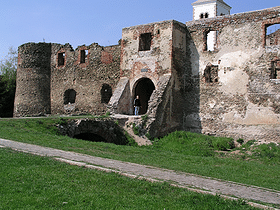


Pozsegaszentpéter (Croatian: Kaptol) is a settlement of great history and historical significance in Croatia, located in eastern Slavonia, in Požega-Slavonia County (Požeško-slavonska županija), where it is the seat of an independent municipality. It lies in the northern part of the Požega Basin, on the southern slopes of the Papuk mountain range, only about 11–12 km northeast of the town of Požega. The considerable ruins of the castle are found in the centre of the settlement.
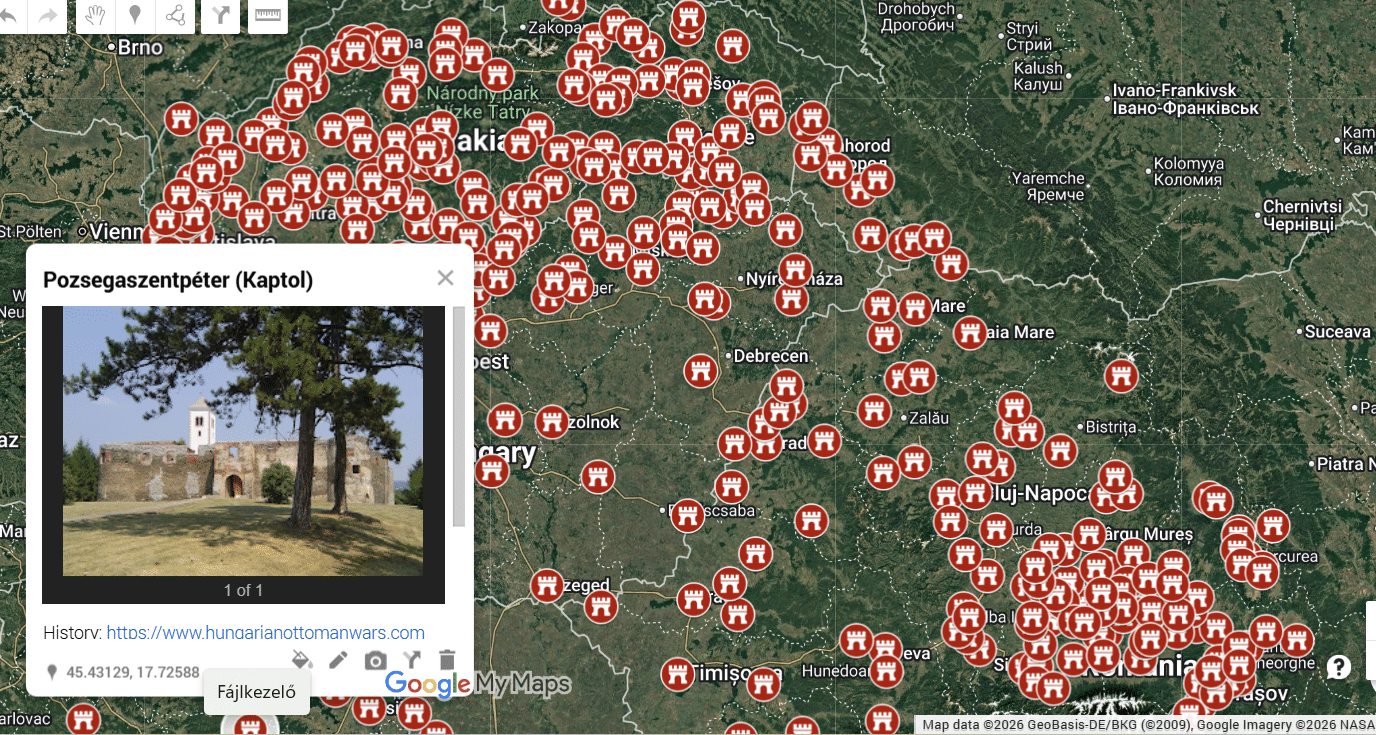
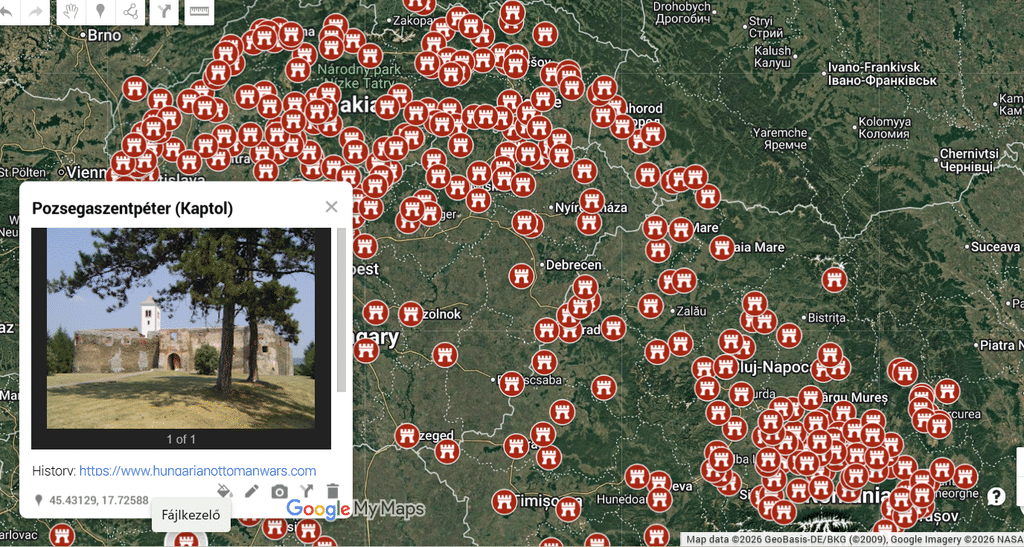
Location on my map: https://tinyurl.com/yvu96fc4
History
The collegiate chapter of Požega (“Capitulum ecclesiae beati Petri de Posega”) was founded in 1221 by Ugrin, Archbishop of Kalocsa, and was placed under the jurisdiction of the Diocese of Pécs. The Hungarian name of the settlement (Pozsegaszentpéter) also refers to this medieval collegiate chapter. The chapter functioned as an important Hungarian place of authentication (locus credibilis) in the Middle Ages, where charters were issued and recorded for the southern territories of the Kingdom of Hungary.

It is certain that the chapter’s buildings were fortified very early on. Its early form was probably a timber wall, a so-called palisade, which surrounded the entire settlement. The stone walls began to be built only at the end of the 15th century. According to the latest research, a separate stronghold of the provost had stood in the settlement since the very beginning, the foundation walls of which have recently been excavated. Within the hexagonal castle stood the late Gothic-Renaissance mansion, the canons’ quarters, the provost’s palace, the council hall, and the Gothic Church of St Peter. The settlement was occupied by the Turks on 15 January 1537, at the same time as the castle of Požega (according to another source, in 1536); the chapter fled at that time. Its archives were first taken to Pécs, then to Upper Hungary (later transported to Budapest, and returned to Croatia in 1960). A Turkish garrison was stationed in the castle, which was rebuilt.

After the expulsion of the Turks (1687), at the end of the 17th century the castle became the property of the Court Chamber, from which the canon Feketich Péter (Petar Crnković) purchased the castle and the estate for the Church, so that the seat of the Diocese of Srem, still under Turkish occupation, could be moved here. In 1773, Pozsegaszentpéter ceased to be an episcopal seat; as a smaller estate, it came under the direction of a canon of the cathedral chapter of Diakovar until 1877. At that time, Count Attems Antal bought the castle together with its estate, which marked the beginning of the castle’s actual decline. The castle’s buildings were converted to meet the economic needs of the estate, and a granary was built from the Baroque church. By the 20th century, the castle had become completely uninhabited and was left to decay.

The Castle’s Present State
The castle of Pozsegaszentpéter (Croatian: Stari grad Kaptol) is one of the best-preserved medieval castles in Slavonia, and at the same time one of its best-preserved medieval water castles (a fortress surrounded by a moat). The medieval castle consisted of two parts: the outer or chapter castle was a fortified chapter settlement, the greater part of which consisted of chapter and other curiae. The castle visible today was the inner or provost’s castle. It contained the provost’s palace, the chapter’s council hall and the Gothic parish church of St Peter.

The castle has an irregular hexagonal ground plan, a defensive system reinforced with circular bastions, four corners of which were protected by round towers with loopholes. Three of these still stand today. Once surrounded by a deep moat, the castle can be entered from the south via a bridge converted from the former drawbridge and through a square gate tower. In its northwestern part, on the site of the former Church of St Peter, the Church of St George was built in the 18th century; it now serves as a warehouse.

Its tower rises far above the castle walls, which are still of considerable height. In the 18th century, major alterations were also carried out on the rest of the castle. The central castle mansion was renovated so it partly took on the character of a mansion; living quarters were created in the south, and, because of this function, it was also extended and remodelled. By the 19th century, only the eastern part of the castle mansion was intact; the western part was already in ruins. In 1943, the entire roof structure burned down, and the buildings were finally abandoned. The Church of St George has recently been renovated.

Other Sights
Hallstatt-period burial mounds (tumuli): At the archaeological sites of Čemernica and Kaptol-Gradci near Kaptol, princely tumuli (burial mounds) of international significance dating from the Early Iron Age (8th–6th century BC) and the remains of a fortified settlement have been excavated.
Surrounding nature and viticulture: Because of the immediate vicinity of the Papuk Nature Park (Park prirode Papuk), it is a popular hiking and cycling destination, and as part of the Kutjevo-Požega wine region, it is also famous for viticulture.

Dear Readers, I can only make this content available through small donations or by selling my books or T-shirts.
Please support me with a coffee here: https://www.buymeacoffee.com/duhoxoxa
You can check out my books on Amazon or Draft2Digital. They are available in hardcover, paperback, or ebook:
https://www.amazon.com/dp/198020490X or at https://books2read.com/b/boYd81
My work can also be followed and supported on Patreon: Become a Patron!http://Become a Patron!
Become a Patron! Donations can be sent by PayPal, too: https://tinyurl.com/yknsvbk7


https://hungarianottomanwars.myspreadshop.com/all
Subscribe to my newsletter here: https://tinyurl.com/4jdjbfkn
Gallery: